
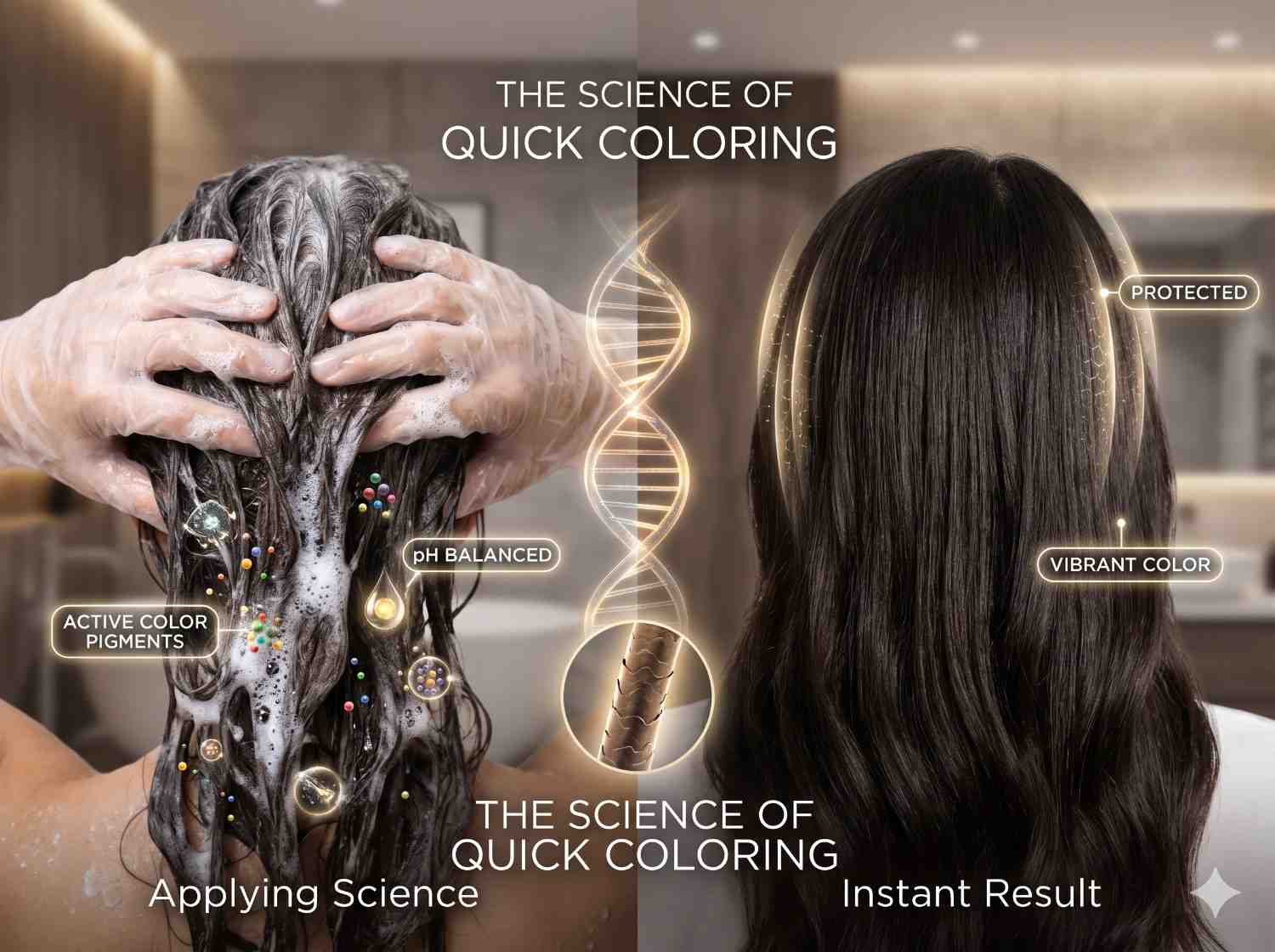
How Does Hair Colour Shampoo Work? The Science Behind Quick Hair Colouring
Colouring grey hair no longer always requires a bowl, brush and lengthy salon appointment. Hair colour shampoos offer a convenient application format, but what actually makes hair turn black or brown in just a few minutes?
How does hair colour shampoo work? Hair colour shampoo delivers colouring ingredients through a shampoo-like product that is distributed over the hair and left on for a specified processing period. Some products use oxidative dye chemistry, in which dye precursors and an oxidising agent react to form coloured molecules. Others rely on direct pigments that attach to the hair. The exact mechanism depends on the formulation, not the word “shampoo” on the label.
Understanding that distinction helps you choose a product, interpret ingredient labels, avoid common mistakes and set realistic expectations about grey coverage, colour longevity and safety.
This guide explains the chemistry behind quick hair colouring, why different formulas behave differently, what ammonia-free really means and how to approach at-home colouring responsibly.
At a Glance: What You Need to Know
Hair colour shampoo is a delivery format rather than a single type of dye. Some products form colour through an oxidation reaction, while others deposit pigments onto the hair. Application may feel similar to shampooing, but colouring products usually require a specific processing time and careful rinsing. Ammonia-free formulas can still contain other alkalising agents, oxidative dye ingredients or substances capable of causing allergies. Grey coverage varies with hair porosity, existing colour, formulation and application. Products described as five-minute or ten-minute colours should be judged by their own verified directions, not by marketing terminology alone. Always read the ingredient list, follow the manufacturer’s allergy precautions and avoid using scalp hair dye on eyebrows or eyelashes.
1. What Is Hair Colour Shampoo?
Hair colour shampoo is a product designed to colour hair using a shampoo-like application method. It may be sold as black hair colour shampoo, instant hair dye shampoo, wash-in hair colour or grey hair coverage shampoo.
These names describe how a product is marketed or applied. They do not automatically reveal whether the colour is temporary, semi-permanent, demi-permanent or permanent.
Is it the same as ordinary shampoo?
No. Ordinary shampoo is primarily formulated to remove sebum, dirt and product residue. A hair colour shampoo has the additional purpose of depositing or developing colour.
Some colouring products contain cleansing surfactants, but others simply use a foaming or massage-in format. The presence of foam does not mean the product cleanses hair like a conventional shampoo.
This matters because consumers sometimes treat colour shampoo as an everyday wash product. Many dye-containing products are intended for occasional colouring rather than routine daily cleansing.
Three main categories of colour shampoo
- Oxidative colour shampoos: Use dye intermediates and an oxidising system to develop colour through a chemical reaction.
- Direct-dye colour shampoos: Contain preformed colourants that deposit onto or partly penetrate the hair fibre.
- Colour-maintaining shampoos: Use small amounts of pigment to refresh an existing shade rather than deliver substantial grey coverage.
A product’s ingredient list and instructions are more reliable than its category name when determining which system it uses.
2. The Science Behind Hair Colour Shampoo
Hair is made mainly of keratin, a structural protein. The visible hair shaft includes an outer cuticle and an inner cortex. Natural hair colour comes largely from melanin pigments located within the hair fibre.
Hair dyes work by adding colour molecules, creating them through chemical reactions or changing existing pigments. The mechanism determines how strongly the colour attaches and how long it remains visible.
How oxidative hair colour works
In an oxidative dye system, small dye precursor molecules are combined with an oxidising agent, commonly hydrogen peroxide. Under suitable conditions, the precursors react to form larger coloured compounds.
Depending on the formula, some of these compounds develop within the hair fibre. The resulting colour can be more resistant to washing than many surface-depositing pigments.
Oxidative colouring typically involves several coordinated functions:
- An alkaline environment helps prepare the hair fibre for colouring.
- Dye precursors move into accessible regions of the hair.
- An oxidising agent initiates colour-forming reactions.
- Couplers and intermediates react to create the intended shade.
- The product is rinsed away after the specified development period.
Not every oxidative system follows exactly the same sequence or uses identical concentrations. The final result depends on formulation chemistry, hair properties and processing conditions.
How direct dyes work
Direct dyes are already coloured before application. They do not need the same colour-forming oxidation reaction as traditional permanent oxidative dyes.
Their molecules can adhere to the hair surface or enter accessible regions of the fibre. Some are designed for temporary colour, while others can last through multiple washes.
Direct-dye systems may be useful for refreshing colour, but their ability to cover resistant grey hair depends on the specific pigments and formula.
Why the hair cuticle matters
The cuticle is the protective outer layer of the hair shaft. Its condition influences how easily substances move into and out of the fibre.
Hair that has been bleached, heat-damaged or repeatedly chemically treated may absorb colour differently from untreated hair.
Porous sections can sometimes take up more pigment, causing darker or uneven results. Conversely, some resistant grey hairs may be harder to colour consistently.
3. How Does Hair Colour Shampoo Cover Grey Hair?
Hair becomes grey or white as pigment production in the follicle decreases. Once the hair shaft grows without much melanin, it appears lighter because less natural pigment is present.
Hair colour shampoo does not normally restore the follicle’s natural pigment production. Instead, it adds artificial colour to the existing hair shaft.
Why black colour can make grey hair look darker
Dark colourants absorb more visible light than unpigmented grey hair. When a suitable dye deposits or develops on grey strands, those strands reflect less light and appear darker.
However, a convincing result requires more than simply adding black pigment. The product must distribute colour evenly and develop a suitable shade without excessive patchiness.
Why some grey strands resist colour
Grey hair is not identical from person to person. Some strands have tightly packed cuticles or different surface characteristics. Previous treatments and product buildup can also influence colouring.
Results may vary between the temples, roots, beard area and lengths of the hair. This is one reason manufacturers specify application methods and processing times.
Does black colour shampoo work on completely white hair?
Some formulations are designed to colour white or predominantly grey hair, but complete coverage should not be assumed. A product may produce a dark shade on one person and a softer or less even result on another.
For predominantly white hair, choose a product with explicit grey coverage directions and realistic shade examples. A strand test can help assess the likely cosmetic result, but it does not replace allergy precautions.
4. Why Can Some Hair Colour Shampoos Work in 5–10 Minutes?
Fast hair colouring is a major selling point in the home-colouring category. Search phrases such as “5-minute hair color shampoo” and “10-minute black hair colour shampoo” reflect interest in shorter application routines.
Yet processing time is a product-specific instruction, not a universal measure of quality or effectiveness.
What influences colouring speed?
- Formulation chemistry: The selected dye system and its reaction conditions affect colour development.
- Ingredient concentration: The amount and balance of active colouring ingredients influence performance.
- Product distribution: Even contact with the hair helps reduce missed areas.
- Hair characteristics: Porosity, texture, previous colouring and grey percentage can change results.
- Processing conditions: Temperature and the time specified by the manufacturer can affect development.
Does faster always mean better?
No. A product that works quickly is convenient, but speed alone does not establish superior coverage, gentleness or colour durability.
Likewise, leaving a product on longer than instructed does not guarantee better results. Overprocessing can increase unwanted exposure and may produce an unexpected shade or additional hair stress.
The correct approach is to follow the exact timing on the product label, including any instructions about when timing begins.
5. Understanding Hair Colour Shampoo Ingredients
Ingredient labels can appear complicated because colouring products combine multiple functions in one formula. Some ingredients create colour, while others control texture, stability, pH, conditioning or preservation.
| Ingredient category | Typical function | What consumers should know |
|---|---|---|
| Oxidative dye intermediates | Participate in colour-forming reactions | Some can cause allergic reactions in susceptible individuals. |
| Oxidising agents | Help develop oxidative colour | Must be used according to the specific formulation instructions. |
| Alkalising agents | Adjust pH for colour development | Ammonia is one option, but not the only one. |
| Direct colourants | Deposit preformed pigments | Colour durability varies considerably by dye type. |
| Surfactants | Support cleansing, spreading or foaming | Foam does not necessarily indicate stronger colouring. |
| Conditioning ingredients | Improve slip, feel and manageability | They do not automatically prevent all chemical hair damage. |
| Botanical extracts and oils | May contribute conditioning, fragrance or other cosmetic functions | Their presence does not establish that the dye itself is plant-based. |
| Preservatives | Help protect suitable formulas against microbial spoilage | Preservation requirements depend on the product system. |
What does ammonia-free really mean?
An ammonia-free hair colour formula does not contain ammonia as a deliberately added ingredient. However, oxidative colour may still require a different alkalising system to support the colouring reaction.
Therefore, “ammonia-free” should not be interpreted as “free from all chemicals,” “non-irritating” or “safe for everyone.”
The most useful comparison is the complete formulation, including dye ingredients, alkalising agents, oxidisers and directions for use.
What does paraben-free mean?
Parabens are a family of preservatives used in certain cosmetic products. A paraben-free formula does not contain those particular preservatives as formulated, but it may contain other approved preservation systems.
Being paraben-free does not, by itself, prove that a product is more effective, safer or less likely to cause an allergic reaction.
Are herbal extracts responsible for black colouring?
Not necessarily. A shampoo can contain plant extracts while relying on synthetic or other non-botanical colourants for its main colouring effect.
For example, a formula described as containing natural extracts may include botanical conditioning ingredients alongside an oxidative dye system.
Similarly, argan oil may appear in some hair care products because of its conditioning properties. It should not be assumed to be present in a particular hair colour shampoo unless listed in the verified ingredients.
Does a 3-in-1 shampoo, conditioner and dye work differently?
“3-in-1” is a product-positioning term. It usually means that the manufacturer intends the formula to combine several functions, but it does not identify a unique chemical colouring mechanism.
A product may contain conditioning agents and colouring ingredients while still requiring separate cleansing or conditioning steps. Always rely on its actual instructions rather than the marketing description.
6. Hair Colour Shampoo vs Traditional Hair Dye vs Henna
Choosing a colouring method becomes easier when you compare the underlying mechanism rather than focusing only on packaging or advertising.
| Feature | Hair colour shampoo | Traditional oxidative dye | Pure henna |
|---|---|---|---|
| Application format | Shampoo-like spreading or massaging | Usually cream or liquid applied with a brush or applicator | Plant powder mixed into a paste |
| Colour mechanism | Depends on formula: oxidative or direct dye | Typically oxidative dye chemistry | Lawsone pigment binds to hair keratin |
| Processing time | Varies by product; some marketed for quick use | Varies by product and intended result | Often substantially longer |
| Grey coverage | Formula-dependent | Can provide substantial coverage when appropriately formulated | Produces copper-to-reddish tones on light or grey hair |
| Black colour possible? | Yes, with a suitable black colour formula | Yes | Pure henna alone does not produce black hair |
| Colour longevity | Depends on dye chemistry and hair | Often longer-lasting with permanent formulations | Can be long-lasting, but tone and fading vary |
| Key consideration | Check actual dye system and safety directions | Check ingredients, mixing and processing instructions | Confirm powder purity and expected shade |
Why pure henna cannot create instant black hair
Pure henna comes from the leaves of Lawsonia inermis. Its principal colouring compound is lawsone, which typically produces orange, copper or reddish-brown tones depending on the starting hair colour.
Black-looking results from plant-based systems may involve additional ingredients such as indigo and a multi-step process. Pure henna alone should not be marketed as an instant black dye.
This distinction is particularly important because products described as “black henna” may sometimes contain additional dyes, including ingredients that require specific safety precautions.
Which method should you choose?
Consider your desired shade, available time, sensitivity history, previous colouring and willingness to maintain the result.
If you value a short application routine, a correctly formulated quick hair colour product may be convenient. If you prefer traditional plant colouring, pure henna or a carefully selected henna-and-indigo process may better match your preferences.
Neither approach is automatically the right choice for every person.
7. How to Use Hair Colour Shampoo Correctly
Proper application is essential because even a well-formulated product can give uneven results if it does not reach the intended hair sections.
The following steps describe general precautions. They do not replace the instructions on a particular product.
Check whether the product requires mixing, whether hair should be wet or dry, how long it must remain on the hair and which precautions apply.
Complete any required allergy alert test at the specified interval before colouring. A negative result cannot guarantee that a reaction will not occur.
Remove accessories, protect clothing and keep the product away from fabrics or surfaces that may stain. Follow any instructions concerning styling products or pre-washing.
Gloves help reduce direct skin contact with colouring ingredients. Use the type supplied or recommended by the manufacturer.
Apply according to the label, paying attention to grey roots, temples and other target areas. Do not assume that vigorous rubbing improves colouring.
Use the specified duration. Do not extend the contact time in an attempt to achieve a darker shade.
Continue rinsing according to the product instructions. Avoid contact with eyes and follow any recommendations for subsequent cleansing or conditioning.
Assess the colour under normal lighting after the hair has dried. If the result is uneven, consult the product instructions rather than immediately repeating the treatment.
Should hair be wet or dry before application?
There is no universal answer. Some products are designed for damp hair, while others require dry hair. Applying a product to the wrong starting condition can dilute the formula or change how evenly it spreads.
Follow the instructions for the exact product in your hands.
Can you use it on a beard or moustache?
Only if the manufacturer explicitly states that the product is suitable for that purpose. Facial skin and the area around the mouth can be more sensitive, and scalp hair colour instructions should not automatically be transferred to facial hair.
8. Why Hair Colour Shampoo Results Vary
Two people using the same shade may not get identical results. Hair is a variable biological material, and previous treatments influence its response to colouring.
Starting hair colour
The original shade influences the final appearance. A black colour applied to predominantly white hair may look different from the same product applied to medium-brown hair.
Hair porosity
Porous hair can take up colour differently from less porous hair. Uneven porosity along the same strand may produce uneven depth or faster fading at the ends.
Percentage and distribution of grey hair
Someone with a few scattered grey strands may experience a different visual effect from someone with a predominantly white hairline.
Previous chemical treatments
Bleaching, straightening, perming and earlier colouring can change hair condition. Certain previous dyes or metallic-salt products may also create compatibility concerns.
Application consistency
Missed sections, uneven product distribution or incorrect processing time can lead to patchy colour.
Lighting and colour perception
Black hair can appear warmer or brownish under strong sunlight. This does not automatically mean that the dye has failed; reflected light and underlying pigment can affect the perceived shade.
9. How Long Does Hair Colour Shampoo Last?
The duration depends mainly on whether the product uses temporary, direct, demi-permanent or permanent dye chemistry. Hair porosity, washing habits and sun exposure can also influence visible fading.
A product described as “instant black hair dye” is not necessarily temporary, and a product described as “shampoo colour” is not necessarily permanent.
What causes colour to fade?
- Repeated washing can remove some deposited colourants.
- Sunlight and environmental exposure can change the appearance of certain dyes.
- Porous or damaged hair may lose some colour more quickly.
- New hair growth reveals the natural root colour, even when the previously coloured lengths remain dark.
- Heat styling and incompatible hair treatments can affect colour appearance.
Does permanent colour mean the hair will stay black forever?
No. Permanent colour refers to the dye system and its relative resistance to washing. It does not stop new grey hair from growing, and the shade can still change with time.
For that reason, maintenance schedules should be based on the specific product and individual hair condition rather than a fixed universal number of days.
10. Hair Colour Shampoo Safety: What Consumers Should Know
Hair colouring products can contain ingredients that irritate the skin or trigger allergic contact dermatitis in susceptible people.
One well-known hair dye allergen is para-phenylenediamine, often abbreviated as PPD. Other dye ingredients can also cause reactions, so a product should not be judged by a single ingredient claim alone.
Ammonia-free does not mean allergy-free
Ammonia-free formulas may still contain oxidative dye intermediates, other alkalising agents, fragrances or preservatives. Each ingredient has its own function and potential for sensitivity.
Similarly, the presence of botanical extracts does not make a product automatically hypoallergenic.
Important precautions
- Read all warnings and follow the manufacturer’s allergy alert testing directions.
- Do not colour hair if your scalp is irritated, damaged or unusually sensitive.
- Avoid colouring after a previous reaction to a hair dye unless a qualified clinician has assessed the risk.
- Keep hair colour away from eyes and do not use scalp hair dye on eyelashes or eyebrows.
- Do not mix different hair colouring products unless the manufacturer explicitly instructs you to do so.
- Wear protective gloves and rinse according to the directions.
- Store products away from children and follow the labelled storage conditions.
What about sensitive scalps?
People with a history of eczema, contact dermatitis or hair dye reactions should be especially cautious. “Gentle,” “herbal” and “ammonia-free” are not substitutes for an assessment of the full ingredient list.
If you have previously reacted to hair dye, consult a dermatologist before considering another colouring product. Professional patch testing may be needed to identify the responsible allergen.
Can frequent colouring damage hair?
The potential for hair damage depends on the formulation, application frequency, processing conditions and the existing condition of the hair.
Some oxidative colouring processes can change the hair fibre, especially when combined with repeated bleaching, heat styling or other chemical treatments.
Conditioning ingredients may improve how hair feels, but they do not prove that a colouring process causes no structural change.
11. How to Choose a Good Black Hair Colour Shampoo
A practical buying decision should begin with ingredient transparency and realistic instructions rather than exaggerated before-and-after claims.
Hair colour shampoo buying checklist
- Clear shade identification: Does the pack specify black, natural black or another shade?
- Complete ingredient declaration: Can you identify the dye system and important allergens?
- Application instructions: Is the process clearly explained?
- Processing time: Does the label state a precise duration?
- Safety warnings: Are allergy and eye-contact precautions visible?
- Quantity: Is the net volume or weight clearly declared?
- Manufacturer details: Is the responsible business identified?
- Batch information: Can the product be traced to a production batch?
- Expiry or period-of-use information: Is it supplied as required for the market?
- Authentic seller: Are you purchasing from a recognised seller or legitimate listing?
Is a 400ml pack a good choice?
A 400ml bottle may offer convenient quantity for some users, but the number of applications depends on hair length, density, product dosage and the manufacturer’s instructions.
To compare value, consider the purchase price together with the expected quantity needed per application. Avoid assuming that a larger bottle always provides more uses if the recommended dose differs.
What should you avoid?
Be cautious with products that promise permanent results in every hair type, claim to be completely risk-free or fail to disclose meaningful ingredient and manufacturer information.
Also be careful when listings use the terms “natural,” “organic,” “chemical-free” or “herbal” without explaining the actual colour-forming ingredients.
12. Common Mistakes When Using Quick Hair Colour Shampoo
- Assuming all products use the same chemistry. Two similar-looking bottles may contain different dye systems.
- Ignoring the allergy instructions. Previous uneventful colouring does not guarantee that a future reaction cannot occur.
- Using the wrong processing time. The instructions for one brand should not be copied to another.
- Applying unevenly. Missed roots and temples can create visible colour differences.
- Using on irritated skin. Damaged or inflamed skin may be more vulnerable to unwanted reactions.
- Expecting pure henna-like ingredients to produce instant black. Colour chemistry must be evaluated separately from botanical marketing.
- Repeating treatment immediately after disappointing results. This may increase exposure without solving the original application problem.
- Judging the final shade while hair is wet. Wet hair often appears darker, making immediate comparison misleading.
Most of these mistakes can be avoided by understanding the product type, following the label and setting realistic expectations before colouring.
13. Hair Colour Shampoo Myths vs Facts
| Common myth | What the evidence supports |
|---|---|
| Hair colour shampoo is just normal shampoo with black pigment. | Some products use oxidative dye systems; others use direct pigments. Formulations differ. |
| Ammonia-free means completely harmless. | Ammonia-free formulas can still cause irritation or allergic reactions. |
| All quick colour shampoos work in five minutes. | Processing time is specific to each tested formulation. |
| Herbal extracts mean the dye is entirely natural. | Plant extracts may coexist with conventional colouring ingredients. |
| Permanent colour never fades. | Colour can change with washing, light exposure and hair condition; new roots also grow. |
| Pure henna can colour grey hair jet black instantly. | Pure henna typically produces copper-to-reddish tones, not instant black. |
| A successful allergy test guarantees no reaction. | Allergy alert tests have limitations and cannot guarantee safety. |
| Leaving dye on longer always improves coverage. | Extra processing may increase unwanted exposure without improving results. |
14. Practical Expert Tips for Better Colouring Decisions
Match the product to your real goal
Someone wanting a temporary colour refresh has different needs from someone seeking substantial grey coverage. Identify whether you want a short-term cosmetic change or a longer-lasting result before shopping.
Check the formulation, not just the headline
Words such as instant, herbal, natural and shampoo can describe very different products. The ingredient list and directions provide more useful information than the headline alone.
Keep your routine consistent
When evaluating a new product, avoid changing several other hair treatments at the same time. A consistent routine makes it easier to understand how your hair responds.
Take photographs in consistent lighting
If you want to compare grey coverage or colour fading, use similar lighting, angles and hair conditions. This provides a more useful comparison than photographs taken under different conditions.
Do not ignore unexpected reactions
Persistent itching, redness or swelling should not be dismissed as a normal part of colouring. Stop use and seek appropriate medical guidance.
15. Frequently Asked Questions About Hair Colour Shampoo
1. How does black hair colour shampoo work?
Black hair colour shampoo delivers colourants through a shampoo-like application. Some formulas use oxidative dye precursors that react to form dark colour molecules, while others deposit preformed pigments. The mechanism depends on the ingredient system. Application convenience does not mean that the product is an ordinary cleansing shampoo. Check the label to understand whether the product is intended for temporary colour, colour maintenance or longer-lasting grey coverage.
2. Does hair colour shampoo permanently colour grey hair?
Some hair colour shampoos use longer-lasting oxidative dye chemistry, while others contain direct pigments that fade more readily. The word “shampoo” does not determine permanence. Even permanent colouring does not prevent new grey roots from growing, and existing colour may gradually change. For an accurate expectation, review the product’s dye system, instructions and claims rather than assuming that all black colour shampoos have the same durability.
3. Can hair colour shampoo work in five minutes?
Certain products are marketed with five-minute processing instructions, but this timing is not universal. Colour development depends on the formulation, starting hair colour and other factors. A ten-minute product should not be treated as a five-minute product simply because both are described as instant colour shampoos. Always follow the exact processing time provided by the manufacturer and do not extend it to force a darker result.
4. Is ammonia-free hair colour shampoo safer than regular hair dye?
Ammonia-free means that ammonia is not used as an ingredient in the formula. It does not prove that the product is free from allergens, irritants or potential hair damage. Some ammonia-free products use alternative alkalising agents and conventional oxidative dye ingredients. Safety depends on the complete formulation, individual sensitivity and correct use. Consumers should read ingredient declarations and follow all warnings, especially if they have previously reacted to hair dye.
5. Does hair colour shampoo contain PPD?
Some oxidative hair colouring products contain PPD or related dye ingredients, while others use different colourant systems. You cannot determine PPD content from terms such as herbal, ammonia-free or shampoo colour. Check the actual ingredient declaration and manufacturer information. People with known hair dye allergies should consult a dermatologist before using another colouring product, because reactions and cross-sensitivities may occur with certain related ingredients.
6. Can hair colour shampoo damage hair?
Hair damage depends on the chemistry of the product, processing conditions, application frequency and the existing condition of the hair. Some oxidative systems can alter hair fibre properties, particularly when combined with bleaching or repeated chemical treatments. Conditioning agents may improve softness and manageability but do not establish that a formula is damage-free. Following instructions and avoiding unnecessary repeat applications are important precautions.
7. Is hair colour shampoo suitable for men and women?
Many hair colouring products are marketed for adults of different genders, because hair colouring chemistry is not inherently gender-specific. Suitability depends more on hair condition, desired shade, product directions, ingredient sensitivity and intended application area. A scalp hair colouring product should not automatically be used on beards, eyebrows or eyelashes. Review the manufacturer’s approved uses before applying it anywhere other than the scalp.
8. Why does black hair colour shampoo sometimes turn hair brown?
The perceived shade can be influenced by the starting hair colour, pigment balance, processing time, porosity and lighting. Dark hair may reveal warm brown tones under bright sunlight, while uneven application can leave some strands lighter than others. Previous chemical treatments may also influence colour uptake. If a result differs from expectations, compare it under consistent lighting and consult the product instructions before considering another application.
9. Can I use hair colour shampoo after henna?
Compatibility depends on the exact henna preparation, any additional ingredients and the hair colour formula you intend to use. Pure henna behaves differently from products containing indigo, metallic salts or undisclosed dyes. Some combinations may produce unexpected shades or other compatibility problems. Disclose previous treatments to a qualified hair professional, follow manufacturer restrictions and consider a strand test for cosmetic results. A strand test does not replace allergy precautions.
10. How often should I use black hair colour shampoo?
There is no single safe or effective frequency for every product. A direct-pigment colour-maintaining shampoo may have different usage directions from an oxidative grey coverage product. Reapplication should follow the manufacturer’s instructions and take into account hair condition and any skin reactions. Do not assume that a product is suitable for daily use merely because the packaging calls it a shampoo.
11. Does herbal hair colour shampoo contain only plant ingredients?
Not necessarily. The term herbal may refer to the inclusion of botanical extracts, oils or other plant-derived components. The colouring effect may still come from oxidative dye ingredients or direct colourants. A product described as containing natural extracts should not automatically be treated as an entirely plant-based dye. Read the complete ingredient list and distinguish conditioning ingredients from the substances that actually create the hair colour.
12. What is the difference between hair colour shampoo and colour-depositing shampoo?
Hair colour shampoo is a broad commercial description that may include oxidative colouring systems. Colour-depositing shampoo more specifically suggests a product that adds preformed pigments during washing, often to refresh an existing shade. However, product terminology is not always consistent across brands and markets. To identify the mechanism, check the colourants, whether separate components must be mixed and the manufacturer’s instructions for use.
16. Key Takeaways
- Hair colour shampoo is an application format, not one universal dye technology.
- Oxidative formulas create colour through chemical reactions; direct dyes deposit existing pigments.
- Grey coverage depends on the product, starting shade, hair condition and application.
- Five-minute and ten-minute claims are product-specific and should not be interchanged.
- Ammonia-free and paraben-free do not mean allergy-free or chemical-free.
- Botanical extracts do not necessarily provide the main colouring action.
- Pure henna alone does not create instant black hair.
- Correct application and safety precautions matter more than exaggerated marketing promises.
17. Conclusion: Understand the Chemistry Before Choosing the Colour
Hair colour shampoo makes home colouring more convenient by changing how colouring ingredients are delivered and applied. Behind that simple application may be a carefully designed oxidative dye system, direct pigments or a combination of cosmetic technologies.
The best way to understand a product is to look beyond the words “instant,” “herbal” and “ammonia-free.” Read the ingredients, check the directions, consider your hair history and understand the limitations of the claimed results.
For anyone considering quick black hair colouring, informed product selection and responsible application are more valuable than assuming that every shampoo-style dye works in the same way.
Explore Hennahub Black Hair Colour Shampoo
Hennahub India offers a 400ml black hair colour shampoo marketed for convenient at-home colouring, with an ammonia-free and paraben-free positioning, natural extracts and supplied gloves. Check the current product label for the complete ingredients, suitability and application directions.
Compare product details, available pack information and purchasing options through the channels below.
Availability, prices and product specifications may differ by seller and country. Verify the listing and label before ordering.
18. Further Reading and Authoritative References
For readers who want to explore hair dye ingredients, cosmetic safety and colouring science in more detail, the following resources provide useful background.
- U.S. Food and Drug Administration: Hair Dyes. Consumer guidance on hair colouring products and relevant safety issues.
- U.S. Food and Drug Administration: Hair Dyes and Relaxers. General regulatory and consumer information.
- PubMed: Research on Oxidative Hair Dye Chemistry. Scientific literature concerning dye intermediates and colouring mechanisms.
- PubMed: Research on Hair Dye Allergy and PPD. Clinical literature on allergic contact dermatitis associated with hair colouring.
- American Academy of Dermatology: Hair and Scalp Care Resources. Dermatologist-informed consumer education.
Editorial transparency: This is general educational content, not medical advice or an independent clinical evaluation of the Hennahub formulation. Specific product claims must be checked against current packaging and supporting documentation.