
Black Hair Color Shampoo FAQ: 200+ Questions Answered
Everything you need to know about Hennahub Natural Black Hair Color Shampoo — usage, grey coverage, ingredients, safety, results, ordering, and more — answered in one place.
What Is Black Hair Color Shampoo, and Why Are Buyers Switching to It?
Black Hair Color Shampoo is an all-in-one shampoo, color, and conditioner that covers grey hair while you wash, without bleach, ammonia, or a separate dye step. Hennahub Natural Black Hair Color Shampoo is formulated to deposit natural-looking black or brown-black pigment onto hair fibers during a normal wash routine, while herbal extracts and a built-in conditioner clean and condition at the same time. Instead of mixing a tube of cream dye with a developer, waiting 30-45 minutes under foil, and rinsing out a strong chemical smell, you simply apply the shampoo to dry or towel-dried hair, leave it on for a short processing time, and rinse. The grey coverage builds gradually with repeated washes, which is exactly why so many regular hair dye users are switching over. For anyone weighing the switch, the appeal usually comes down to three things: less time spent on color maintenance each month, less chemical exposure to skin and scalp, and a softer, more natural-looking result that doesn't carry the flat, uniform look sometimes associated with permanent dye.
The mechanism is simpler than people expect. Each wash deposits a small, controlled layer of color-binding pigment onto the hair shaft, similar to how henna or other natural colorants stain hair gradually rather than instantly. The first application gives a noticeable shift, especially on lighter grey strands, and each following wash builds the depth of color further until grey hair is fully blended into the surrounding natural shade. This gradual build is actually a benefit, not a limitation — it means there's no risk of an unnatural, flat, "dyed" look that can happen with permanent color, and there's far less room for visible mistakes like patchy roots or harsh demarcation lines. Because each wash only adds a thin layer of pigment, even an uneven application tends to even itself out over the next one or two washes, which is part of why the system is considered far more forgiving for beginners than a single, high-stakes dye session.
Traditional hair dye relies on ammonia to lift the hair cuticle and peroxide to develop the color, both of which can leave hair feeling dry, brittle, or chemically damaged over repeated use. Black Hair Color Shampoo skips this oxidative process almost entirely, which is why it's positioned as a gentler, lower-maintenance alternative for people who want consistent grey coverage without committing to a salon schedule or tolerating the strong odor and processing time of conventional dye. For busy professionals, frequent travelers, and anyone who simply finds salon visits inconvenient, washing color into hair during a normal shower is a meaningful upgrade in convenience. It also removes the anxiety many people feel about timing a chemical dye precisely, since there's no risk of leaving a strong developer on too long or too short — the gentler shampoo-based formula is far more tolerant of small variations in processing time.
Benefits go beyond convenience. Because the formula is shampoo-based, it cleanses hair and scalp while coloring, eliminating the need for a separate wash-color-condition routine. Herbal ingredients commonly used in natural hair care — such as amla, bhringraj, and hibiscus extracts — are often included to support scalp health and add shine, rather than just acting as inert filler. A built-in conditioner counteracts the slight drying effect that any colorant can have, which is part of why users frequently report that hair feels softer after switching from chemical dye to shampoo-based color, not drier. Amla is traditionally valued for supporting hair strength and shine, bhringraj is often associated with scalp nourishment, and hibiscus is commonly used in herbal hair care for its conditioning and softening properties — together they round out a formula that's doing far more than just depositing color with each wash.
Both men and women use Black Hair Color Shampoo, though usage patterns differ slightly. Men often use it for fast, low-effort coverage of scalp hair, beard, and moustache grey, applying it weekly as part of a normal grooming routine. Women commonly use it to extend the time between salon root touch-ups, maintaining color on regrowth without scheduling a separate appointment every few weeks. Both groups value the same core benefit: maintaining a natural, even color without repeating a multi-step chemical dye process. Men typically reach a comfortable maintenance rhythm faster simply because shorter hair needs less product per wash, while women with longer hair may need a slightly more generous application to ensure even coverage from root to length, especially during the initial build-up period.
Grey coverage performance depends on how much grey is present and how resistant it is. Lightly grey or salt-and-pepper hair typically shows visible coverage from the very first wash, since there's less pigment resistance to overcome. Fully white or stubborn resistant grey, especially coarse grey hair, often needs two to four applications before reaching full, even coverage, because resistant grey hair has a smoother cuticle structure that absorbs pigment more slowly. This is one of the most common points of confusion for first-time users, who sometimes expect salon-level results from a single wash and are disappointed when grey is still partially visible — when in reality, the product is simply still building. Staying patient through the first three or four washes, rather than judging the product after a single application, is consistently the single biggest factor separating satisfied long-term users from first-time users who give up too early.
The convenience factor is arguably the single biggest reason people switch. There's no mixing bowl, no developer, no gloves-and-foil routine, and no 24-48 hour waiting period between dye sessions that traditional color often requires for hair health. You can color your hair on the same schedule as your regular wash day, in the same amount of time, with no extra step beyond applying the product and leaving it on slightly longer than a normal shampoo. For anyone managing a busy schedule, this single change — folding color maintenance into an existing routine instead of adding a new one — is often the deciding factor.
There are a few common misconceptions worth addressing directly. The first is that shampoo-based color works exactly like permanent dye after one use; in reality it builds gradually, and judging results after a single wash is the most common cause of disappointment. The second misconception is that herbal or shampoo-based formulas can't produce true black — when used consistently as directed, Hennahub Black Hair Color Shampoo is formulated specifically to deliver a natural black to black-brown result, not just a subtle tint. The third misconception is that "natural" or "herbal" automatically means hypoallergenic; while the formula avoids ammonia and bleach, a patch test is still recommended before full use, as with any cosmetic product, since individual sensitivities can vary. A fourth misconception worth dispelling is that shampoo-based color can't be combined with other hair care habits — in practice, it fits comfortably alongside regular trims, occasional deep conditioning, and other herbal treatments, as long as they're scheduled on non-coloring wash days.
Hennahub Black Hair Color Shampoo is best understood as a convenient all-in-one Shampoo + Color + Conditioner solution designed for fast and easy grey hair coverage — built for people who want consistent, natural-looking results without the time, mess, or chemical exposure of traditional hair dye. The sections below answer over 200 specific questions about how it works, how to use it, what results to expect, and how to order it, covering everything a first-time buyer or long-term user might need to know.
Section 1: General Questions
Black Hair Color Shampoo is a wash-in product that cleans, colors, and conditions hair in a single step, instead of requiring separate shampoo, dye, and conditioner routines. Hennahub Natural Black Hair Color Shampoo deposits black or black-brown pigment onto hair fibers while it cleanses, gradually covering grey with repeated washes. It skips ammonia and bleach, relying on color-binding compounds and herbal extracts similar to how natural colorants like henna stain hair over time. Most people apply it exactly like a regular shampoo, just leaving it on slightly longer before rinsing. For anyone who finds traditional hair dye messy, time-consuming, or harsh-smelling, it offers a simpler way to maintain consistent grey coverage as part of an everyday wash routine, without ever mixing a separate dye.
Hair Color Shampoo works by combining cleansing agents with color-binding pigments that attach to the outer layer of the hair shaft during washing. Each application deposits a thin, controlled layer of color, similar to how a natural dye gradually stains hair rather than instantly changing it. Over several washes, this layered deposit builds up, covering grey hair fully and blending it with the surrounding natural color. Because the pigment bonds externally rather than through an oxidative chemical reaction inside the hair shaft, the process is gentler than permanent dye. Herbal extracts and a built-in conditioner included in the formula also help cleanse the scalp and keep hair feeling soft, so the coloring step doesn't compromise hair health the way repeated chemical dyeing often does.
The biggest difference is the process: hair dye requires mixing cream color with a developer, applying it section by section, waiting 30-45 minutes, and rinsing out a strong chemical smell, while Hair Color Shampoo is simply applied during a normal wash and rinsed out like regular shampoo. Hair dye uses ammonia and peroxide to lift the cuticle and permanently deposit color in one sitting, while shampoo-based color builds gradually over multiple washes without that oxidative process. This makes Hair Color Shampoo lower-maintenance and gentler on hair, though it also means results aren't instant the way permanent dye is. Many people choose Black Hair Color Shampoo specifically to avoid the time commitment and chemical exposure that traditional dye requires.
Hair Color Shampoo suits anyone who wants consistent grey coverage without the time, mess, or chemical intensity of traditional hair dye. It's especially popular with busy professionals who can't fit in regular salon visits, frequent travelers who need a low-maintenance routine, and people with mild to moderate grey hair who want gradual, natural-looking coverage rather than an abrupt color change. It also appeals to anyone sensitive to the smell or chemical exposure of ammonia-based dyes. It's less suited to people seeking instant, salon-level transformation in a single sitting, since shampoo-based color builds over repeated washes rather than working immediately, so patience over the first few applications is part of getting the best results.
Yes, men commonly use Black Hair Color Shampoo for fast, low-effort grey coverage on scalp hair, beard, and moustache. Many men prefer it specifically because it fits into an existing grooming routine without adding a separate coloring step — they simply apply it during a regular shower, leave it on for the recommended time, and rinse. Weekly use is typical for maintaining consistent coverage, since men often keep their hair shorter and need more frequent touch-ups to keep new growth blended. It's a practical alternative to visiting a barber or salon for grey coverage every few weeks, and many men describe it as the easiest part of their haircare routine once they settle into a consistent schedule.
Yes, women use Hair Color Shampoo just as commonly as men, often to extend the time between salon root touch-ups or to maintain color on regrowth without booking a separate appointment. Because the formula builds gradually, it works well for women managing longer hair who want even coverage from root to length without the harsh demarcation line that permanent dye can sometimes create at the regrowth point. Many women alternate between salon coloring for major changes and shampoo-based color for ongoing maintenance in between visits. It's also a popular option for women who want to reduce overall chemical exposure to their hair and scalp without giving up consistent grey coverage entirely.
No, Black Hair Color Shampoo is not a permanent dye in the traditional chemical sense, but it is designed to build long-lasting, wash-resistant color through repeated use rather than a single application. Permanent dye changes hair color through an oxidative chemical reaction that doesn't fade with washing, while shampoo-based color sits on the hair shaft's surface and gradually intensifies with each wash, then slowly fades over several weeks if reapplication stops. This makes it more accurately described as a "build-up" or semi-permanent system rather than a one-time permanent change. For most regular users, consistent weekly or bi-weekly use keeps color looking continuously maintained, similar in practical effect to permanent dye without the same chemical process.
Hair color cream is a thick, paste-like product mixed with a developer and left on hair for a fixed processing time before rinsing, typically used for a complete, immediate color change. Black Hair Color Shampoo is a liquid, wash-in formula used during a normal shower, with no separate mixing step and no developer required. Color cream usually delivers a stronger, more immediate result in one application, while shampoo-based color builds gradually but is far more convenient for ongoing maintenance. Many people use color cream for the first, fuller transformation and then switch to a shampoo-based formula afterward to maintain that color with much less time and effort on a week-to-week basis.
Black Hair Color Shampoo is generally suitable for adult users of any age experiencing grey hair, from early greying in younger adults to fuller grey coverage in older users. There's no specific upper age limit, and many elderly users find it easier to apply than traditional dye since there's no mixing, timing, or strong odor involved. It's not intended or marketed for use by minors, since hair coloring products in general are formulated and tested with adult use in mind. As with any cosmetic product, individual skin and scalp sensitivity can vary by age and health condition, so a patch test before full use is recommended regardless of how old the user is.
Yes, Black Hair Color Shampoo is specifically designed to be beginner-friendly, since it removes the most technical and error-prone parts of traditional hair coloring — mixing ratios, developer strength, and precise timing. There's no risk of uneven mixing or guessing how much developer to use, since the product is ready to use straight from the bottle. Beginners simply apply it like a regular shampoo, leave it on for the recommended time, and rinse. The main learning curve is understanding that results build gradually over a few washes rather than appearing instantly, which is the most common point of confusion for first-time users expecting one-application transformation.
Yes, Black Hair Color Shampoo is well suited to travel since it eliminates the need to pack separate dye, developer, gloves, and application tools. A single bottle handles cleansing and coloring together, making it easy to maintain grey coverage on trips, business travel, or any situation where a salon visit isn't practical. Because there's no mixing or precise timing required, it's also simpler to use in unfamiliar bathrooms or rushed schedules compared to traditional dye application. Frequent travelers often cite this convenience as one of the main reasons they switched from salon coloring or at-home dye kits to a shampoo-based maintenance routine that fits into normal travel toiletries.
Section 2: Grey Hair Coverage
Yes, covering grey hair is the primary purpose of Black Hair Color Shampoo. The formula deposits black or black-brown pigment onto grey strands with each wash, gradually blending them with surrounding natural hair color. Light to moderate grey coverage, such as salt-and-pepper patterns, typically shows visible results from the very first application, since there's less pigment resistance to overcome. The coverage continues to build and even out with each subsequent wash, reaching full, consistent coverage usually within two to four applications depending on how much grey is present and how resistant the hair texture is. Regular use after that point maintains the coverage as new grey growth appears at the roots.
Yes, but fully white or stubborn grey hair generally needs more applications than salt-and-pepper hair before reaching complete coverage. White hair often has a smoother, more resistant cuticle structure that absorbs pigment more slowly than hair that still has some natural color mixed in. Most users with significant white hair see meaningful coverage by the second or third wash, with full, even coverage typically achieved by the fourth application. Patience during this build-up period is important, since judging results after only one wash can be misleading. Once full coverage is reached, maintaining it with regular use is generally faster than the initial coverage process.
Most users need between two and four applications to reach full, even grey coverage, though this varies based on how much grey is present and how resistant the hair texture is. Light grey or salt-and-pepper hair often shows strong results after just one or two washes, while fully white or coarse, resistant grey hair may take three to four applications to reach complete coverage. After the initial build-up period, regular weekly or bi-weekly use is typically enough to maintain consistent color and cover new root growth as it appears. Expecting full coverage from a single wash is the most common reason people are initially unsatisfied with results.
Yes, Black Hair Color Shampoo is applied throughout the hair during washing, which naturally includes the roots and regrowth area. This makes it particularly useful for maintaining coverage on new grey growth between salon visits, since you don't need a separate root-touch-up product or technique. Applying the shampoo with attention to the root area, where new grey typically appears first, helps ensure even coverage rather than leaving a visible line between colored length and grey roots. Because the application method is the same as regular shampooing, covering roots doesn't require any special technique beyond making sure the product reaches the scalp area during application.
Yes, but resistant grey hair — often coarser in texture with a tighter, smoother cuticle — typically requires more applications and slightly longer processing time per wash to achieve full coverage compared to finer or more porous grey hair. The pigment still binds to resistant grey strands the same way, it simply takes more repeated exposure to build up a visible, even result. Leaving the product on for the full recommended time rather than rinsing early makes a noticeable difference for resistant hair types. Some users with very resistant grey hair also find that a light, gentle pre-wash with warm water to open the cuticle slightly improves how well the color develops.
Some unevenness after the very first wash is normal and expected, since the color hasn't fully built up yet and different grey strands absorb pigment at slightly different rates. This is not a sign of product failure — it's simply the natural result of a gradual, build-up coloring system rather than an instant one. Patchiness typically smooths out and evens by the second or third application as coverage deepens across all grey strands. Applying the product evenly and making sure every section of hair, especially around the crown and temples where grey often concentrates, gets equal coverage during application helps minimize unevenness in the early washes.
Yes, the contrast between grey hair and surrounding natural color affects how noticeable the coverage process looks. On naturally dark hair, grey strands stand out more sharply before treatment, so the coverage improvement is often more visually dramatic once the color builds up. On naturally lighter or already greying hair overall, the transition can look more subtle since there's less contrast to begin with. In both cases, the final result is a consistent black or black-brown shade across previously grey areas, blending them into the rest of the hair rather than leaving a separate, distinguishable tone.
Yes, with consistent use, Black Hair Color Shampoo can cover hair that is entirely grey or white, though it typically requires more applications than partial grey coverage. Since there's no competing natural pigment to blend with on fully white hair, the deposited color shows up clearly once enough layers have built up, usually reaching near-complete coverage by the third or fourth wash. Some users with 100% grey hair choose to do their first few applications closer together, every two to three days instead of weekly, specifically to accelerate the initial build-up phase before settling into a regular maintenance schedule.
Once the color has fully developed and dried after rinsing, normal humidity and sweating don't strip or fade the coverage, since the pigment has bonded to the hair shaft rather than sitting on top as a temporary coating. During the application and processing window itself, excessive sweating or getting hair wet again before rinsing can interfere with how evenly the product develops, so it's best to avoid heavy exercise or rinsing the product out too early. After the recommended processing time and a proper final rinse, the color holds up normally through everyday humidity, sweat, and activity just like any other wash-in color treatment.
Grey hair often concentrates more heavily at the crown and temples, and these areas can sometimes need slightly more focused application since they tend to have a higher proportion of resistant grey strands. Making sure to massage the product thoroughly into the crown area during application, rather than just at the hairline, helps ensure even coverage across the whole head. Some users find the crown takes one extra wash to fully match the rest of the hair simply because of the higher concentration of grey there, which is a normal pattern rather than a sign of uneven product performance.
The coverage is long-lasting but not permanent in the chemical sense — it gradually fades over several weeks if you stop using the product, similar to how the color built up gradually in the first place. Most users maintain full coverage indefinitely simply by continuing regular weekly or bi-weekly applications, which refresh the color before noticeable fading occurs and also cover new grey growth at the roots. If use is stopped entirely, expect the color to fade gradually back toward natural grey over four to eight weeks rather than washing out abruptly, which is a smoother, less jarring transition than stopping permanent dye use.
Section 3: Usage Questions
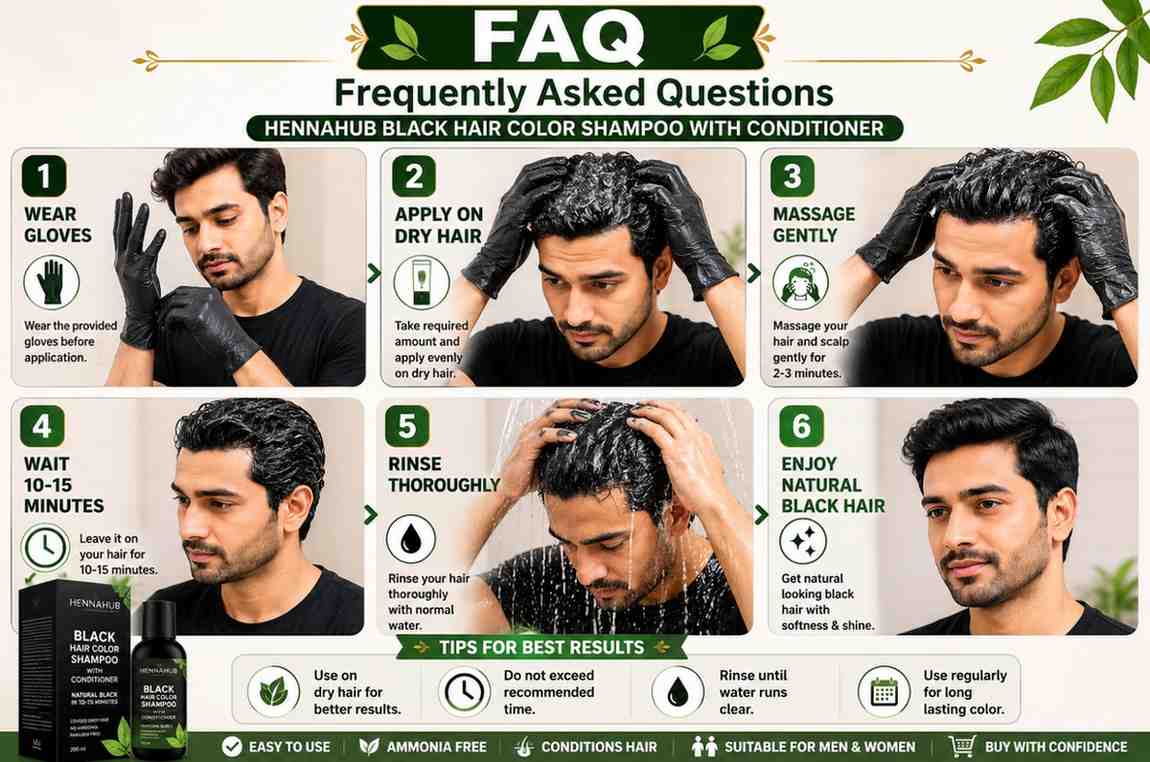
Apply Black Hair Color Shampoo to dry or towel-dried hair rather than soaking wet hair, working it through thoroughly from roots to ends, with extra attention to grey-concentrated areas like the crown and temples. Leave it on for the recommended processing time, typically 15-30 minutes depending on how much grey needs covering, then rinse thoroughly with water only — avoid shampooing again immediately afterward, since a second wash can strip out the pigment just deposited. Repeat weekly for the first few applications to build coverage, then reduce to a maintenance schedule once full coverage is reached. Always wear gloves during application to avoid staining your hands.
No, it's best applied to dry or just towel-dried hair rather than soaking wet hair straight out of the shower. Wet hair holds extra water that can dilute the pigment and reduce how effectively it binds to the hair shaft, leading to weaker color results. Dry hair, or hair that's been towel-dried to remove excess water, allows the product to coat each strand more concentrated and evenly. If your hair is freshly washed and still damp, it's better to let it dry partially or fully before applying, rather than applying immediately after rinsing out regular shampoo.
Most users leave Black Hair Color Shampoo on for 15 to 30 minutes, depending on how much grey coverage is needed and how resistant the hair is. For regular maintenance washes where coverage is already established, 15-20 minutes is usually sufficient. For the first few applications, or for stubborn, resistant grey hair, closer to 30 minutes gives the pigment more time to fully develop and bind. Leaving it on significantly longer than the recommended maximum doesn't typically improve results further and isn't necessary, while rinsing it out too early is one of the most common reasons users see weaker-than-expected coverage.
The right amount depends on hair length and thickness, but as a general guide, short hair typically needs a coin-sized amount, medium-length hair needs roughly double that, and long or thick hair may need three to four times as much to ensure full coverage from roots to ends. Using too little product often results in patchy or incomplete coverage, especially at the back of the head or along the hairline, since there isn't enough product to coat every section evenly. It's better to apply slightly more than too little, working it through systematically section by section rather than trying to stretch a small amount across the whole head.
Yes, Black Hair Color Shampoo is designed for easy self-application without needing a second person or professional help, unlike traditional dye which often benefits from assistance for even back-of-head coverage. Using a mirror to check the back and crown area, or sectioning hair into four quadrants before applying, helps ensure even coverage when working alone. Wearing gloves protects your hands from staining during application. Many users apply it in the shower as part of their normal wash routine, which makes self-application straightforward since it follows the same physical motions as regular shampooing rather than requiring a separate technique.
No, a separate pre-wash with regular shampoo isn't necessary and can actually reduce effectiveness by stripping natural oils that help the product distribute evenly. Black Hair Color Shampoo is designed to cleanse and color in the same step, so applying it directly to dry or towel-dried, unwashed hair is the recommended approach. If hair has heavy product buildup, oil, or styling residue, a light rinse with water alone before application is fine, but using a separate cleansing shampoo first isn't part of the recommended routine and may interfere with how well the color develops.
Yes, using a wide-tooth comb after applying the product can help distribute it more evenly through the hair, especially for longer or thicker hair where finger application alone might miss sections. Combing through gently after applying ensures the product reaches from roots to ends consistently rather than concentrating near the scalp. Avoid aggressive brushing, which can cause unnecessary friction and potential breakage while the product is processing. A few gentle passes with a wide-tooth comb immediately after application is typically enough to even out distribution without disrupting how the color develops over the processing time.
Sectioning isn't strictly required for shorter hair, but it's a helpful technique for longer or thicker hair to ensure every part gets equal coverage. Dividing hair into four sections — front-left, front-right, back-left, back-right — and applying the product to each section individually before combing through reduces the chance of missed spots, particularly at the back of the head where self-application is harder to monitor. For shorter hair, simply working the product through systematically from front to back, side to side, is usually sufficient without formal sectioning.
No, leaving it on significantly longer than the recommended 15-30 minute window, such as overnight, isn't recommended and doesn't improve coverage beyond what the standard processing time achieves. Extended exposure can increase the risk of scalp irritation for sensitive users without providing meaningfully better color results, since the pigment-binding process has a practical saturation point within the recommended timeframe. If you want stronger coverage, it's better to do more frequent applications at the recommended duration rather than extending a single application's processing time well beyond what's suggested on the product instructions.
Lukewarm to cool water is generally recommended for rinsing Black Hair Color Shampoo out, since very hot water can open the hair cuticle more aggressively and potentially cause the freshly deposited color to fade slightly faster. Cool water helps seal the cuticle after the color has developed, which can support better color retention between applications. This same principle applies to regular hair washing after coloring — using cooler water for rinses in the days following application can help the color last longer compared to consistently washing with very hot water.
It's generally better to let hair air-dry or towel-dry gently after rinsing out Black Hair Color Shampoo, rather than applying direct heat immediately. Freshly colored hair, even with a gentle shampoo-based system, can be more sensitive to heat right after processing, and high heat styling immediately afterward may affect how the color settles. Waiting a few hours, or styling the next day, gives the color time to fully set. If you do need to blow-dry soon after, using a lower heat setting and keeping the dryer moving rather than concentrating heat on one area is the safer approach.
Section 4: Result Questions
Hennahub Black Hair Color Shampoo is formulated to produce a natural black to black-brown result, blending grey hair into the surrounding natural color rather than creating an artificially flat, uniform black. The exact depth of color depends on your natural hair tone, how much grey is present, and how many applications you've done, but most users reach a deep, natural-looking black-brown shade after three to four washes. The result is designed to look like natural dark hair rather than an obviously "dyed" appearance, with subtle warmth and dimension rather than a single flat tone.
Yes, the gradual build-up process is specifically what gives shampoo-based color its natural appearance, since the pigment blends with your existing hair tone over several applications rather than instantly overwriting it the way permanent dye can. This avoids the flat, overly uniform look that sometimes comes with single-application chemical dye, and instead produces color with natural-looking depth and variation. Because coverage builds gradually rather than appearing all at once, there's also less risk of an obvious, harsh line between newly colored and natural hair, which contributes significantly to a more believable, natural overall result.
Once fully built up, the color typically lasts seven to ten washes before noticeably fading if you stop reapplying, though most regular users simply continue weekly or bi-weekly applications to maintain continuous coverage rather than letting it fade. Unlike permanent dye, the fade is gradual rather than abrupt, so there's no sudden, jarring transition back to grey. Maintaining a consistent application schedule is the most reliable way to keep color looking fresh continuously, since each new application refreshes both the overall depth of color and covers any new grey growth at the roots.
Most users see a visible color shift after the very first application, especially on lighter grey or salt-and-pepper hair, though full, even coverage typically takes two to four washes depending on how much grey is present and how resistant the hair texture is. It's important to judge results across multiple applications rather than expecting a complete transformation from a single wash, since the system is designed to build gradually. Users with fully white or very resistant grey hair should expect to wait slightly longer, often three to four applications, before reaching their final, fully blended result.
Yes, many users report noticeably shinier hair after using Black Hair Color Shampoo, largely thanks to the built-in conditioner and herbal extracts included in the formula, which coat and smooth the hair shaft as they cleanse and color. This is one of the practical advantages of a shampoo-based system over harsh chemical dye, since the conditioning step happens automatically in the same wash rather than requiring a separate deep-conditioning treatment afterward. Hair often feels softer and looks glossier compared to hair colored with ammonia-based dye, which can leave strands feeling drier and more porous after repeated use.
The packaging shows a representative result, but the exact final shade can vary slightly depending on your starting hair color, how much grey is present, hair porosity, and how many applications you've done. Naturally darker hair tends to reach a richer, deeper black-brown result more quickly, while lighter or more porous hair may show a slightly different undertone. This is normal and expected with any hair coloring product, natural or chemical. Doing a strand test before full application, and reassessing after two to three washes rather than just one, gives the most accurate sense of your personal end result.
When applied evenly and used on a consistent schedule, fading tends to happen gradually and uniformly across the hair rather than in noticeable patches. Uneven fading is more likely if application itself was inconsistent — for example, if certain sections received less product during a previous wash. Maintaining a regular reapplication schedule prevents most fading issues from becoming visible in the first place, since new color is added before significant fading occurs. If uneven fading does happen, an extra focused application on the lighter areas during the next wash usually evens things back out within one or two uses.
It's possible for color to build up darker than expected if applications are done very frequently without allowing the usual gradual buildup pattern, or if the product is left on significantly longer than recommended. For most users following the standard schedule and processing time, the result settles into a natural black to black-brown range rather than an unnaturally flat, overly dark black. If your result looks darker than desired, spacing out applications further apart, such as moving from weekly to every ten days, typically allows the color to settle into a slightly softer depth over the following washes.
Like most hair colors, the result can appear slightly different under various lighting conditions — sunlight often reveals subtle warm undertones in the color that aren't as visible indoors, while indoor lighting, especially warm-toned bulbs, can make the color look slightly deeper or more uniform. This is a normal characteristic of hair color generally, not specific to shampoo-based systems, and reflects how light interacts with hair pigment rather than any inconsistency in the product itself. Most users find the color looks natural and consistent across typical everyday lighting conditions.
Yes, to a point — repeated applications continue to deepen and even out the color until it reaches a natural saturation point, after which further washes mainly maintain that depth rather than continuing to intensify it indefinitely. This saturation point typically occurs around the fourth or fifth application for most users. After reaching it, the color stays consistently maintained with regular use rather than progressively darkening further, since the hair shaft can only hold so much deposited pigment before reaching its natural maximum for that formula.
Yes, chemically treated hair — such as previously bleached, permed, or relaxed hair — often has a more porous structure that can absorb pigment faster, sometimes resulting in a slightly deeper or quicker-building color compared to untreated, virgin hair. This isn't a safety concern, but it does mean chemically treated hair may need fewer applications to reach full coverage, or may benefit from slightly shorter processing times to avoid the color building darker than intended. Doing a strand test is especially useful for chemically treated hair to gauge how it responds before committing to a full application.
Section 5: Ingredient Questions
Hennahub Black Hair Color Shampoo combines cleansing surfactants, color-binding compounds that deposit black or black-brown pigment, herbal extracts such as amla, bhringraj, or hibiscus for scalp and hair conditioning support, and a built-in conditioning agent to offset any drying effect from the coloring process. The formula is built around natural and herbal-derived ingredients rather than ammonia, peroxide, or bleach, which is the core difference from conventional chemical hair dye. Exact ingredient lists can vary slightly by formulation batch, so checking the product label directly is recommended for anyone with specific ingredient sensitivities or allergies before first use.
Yes, herbal extracts are a core part of the formula, commonly including ingredients like amla, bhringraj, hibiscus, or similar botanicals traditionally used in herbal hair care products. These extracts are included not just for marketing appeal but to support scalp comfort and add shine and softness alongside the coloring function. This herbal-forward approach is consistent with Hennahub's broader product philosophy, which favors natural and plant-derived ingredients across its henna, indigo, and herbal hair care lines rather than relying purely on synthetic chemical formulations.
The built-in conditioner offsets the slight drying effect that any coloring process, even a gentle one, can have on hair by helping to smooth the cuticle and lock in moisture after the cleansing and coloring step. This is one of the practical advantages of an all-in-one formula — instead of needing a separate deep-conditioning treatment after using harsher chemical dye, the conditioning happens automatically within the same wash. Many users report their hair feels noticeably softer after switching to a shampoo-based color system specifically because of this built-in conditioning step working alongside the color deposit.
No, Black Hair Color Shampoo does not contain ammonia. Ammonia is used in traditional permanent hair dye to open the hair cuticle so synthetic dye molecules can penetrate and react inside the hair shaft, but it's also responsible for the strong chemical smell and much of the drying, damaging effect associated with conventional dye. By avoiding ammonia, Black Hair Color Shampoo offers a gentler coloring process, though this also means the coloring mechanism works differently — depositing pigment onto the hair surface gradually rather than chemically altering the hair from within in a single application.
No, Black Hair Color Shampoo does not contain bleach. Bleach is used to lighten hair by stripping out natural pigment, which is the opposite function of what this product is designed for — depositing darker pigment rather than removing existing color. Since the formula is intended for grey coverage and darkening rather than lightening, bleach has no role in how it works. This also means the product is gentler overall, since bleach is one of the most damaging chemical processes commonly used in hair treatments, and its absence is part of why this formula is positioned as a milder alternative.
Many natural and herbal-focused hair color shampoo formulas, including Hennahub's, are developed with a preference for minimizing or excluding parabens and other synthetic preservatives where possible, aligning with the broader herbal positioning of the product. Exact formulation details can vary by batch and region, so checking the current ingredient label on your specific bottle is the most reliable way to confirm paraben status for your purchase. Buyers with specific concerns about parabens or other preservatives should review the ingredient list directly or reach out to Hennahub for current formulation details before purchasing.
Yes, Hennahub sources many of its herbal ingredients, including henna and complementary botanicals like amla and bhringraj, from India, consistent with the company's broader manufacturing base in Sojat, Rajasthan, a region known for high-quality henna and herbal raw material production. This sourcing approach reflects Hennahub's identity as an Indian manufacturer and exporter of henna and herbal hair care products, with ingredient sourcing closely tied to the same supply chain used for its other henna, indigo, and herbal powder product lines.
Formulations can vary, and sulfate content depends on the specific cleansing agents used in a given batch, so checking the ingredient label on your bottle is the most accurate way to confirm sulfate content. Many natural hair color shampoo brands aim for milder surfactant systems compared to standard commercial shampoos, since harsher sulfates can strip color and dry out hair more quickly, which would work against the product's coloring and conditioning goals. Buyers with specific sulfate sensitivities should review the current label or contact Hennahub directly for formulation specifics before purchase.
The black or black-brown result comes from color-binding pigment compounds in the formula designed specifically to deposit darker tones onto hair fibers, working alongside the herbal extracts that support overall hair and scalp condition. This is different from how natural henna alone works, since pure henna produces a reddish tone rather than true black — Black Hair Color Shampoo is formulated with this specific darkening function in mind, similar to how henna-indigo combinations are traditionally used together to achieve black or dark brown results rather than henna's natural red-orange shade alone.
Many herbal hair color shampoo formulas use a combination of natural extract scents and a light added fragrance to ensure a pleasant, consistent smell across batches, since natural ingredients alone can vary in scent intensity from batch to batch. The goal is typically a mild, non-overpowering scent rather than the strong chemical odor associated with ammonia-based dye. Buyers sensitive to fragrance, whether natural or synthetic, should check the ingredient label for specific fragrance components or consider a patch test that includes leaving the product on for the recommended time to assess scent tolerance.
Yes, the full ingredient list is typically printed on the product packaging and is also often available on the product listing when purchasing through the Natural Hair Color Shampoo page on Hennahub's online store. Reviewing the ingredient list before purchase is especially useful for buyers with known sensitivities, allergies, or specific preferences around ammonia, sulfates, or parabens. If the ingredient list isn't clearly visible on a particular sales channel, reaching out directly to Hennahub for current formulation details before purchasing is recommended.
Section 6: Safety Questions
Yes, Black Hair Color Shampoo is formulated to be a gentler alternative to traditional chemical hair dye, avoiding ammonia and bleach in favor of color-binding compounds and herbal extracts. It's generally considered safe for regular use by adults when applied as directed. As with any cosmetic or hair coloring product, individual skin and scalp sensitivities can vary, so a patch test before the first full application is recommended to rule out any personal allergic reaction. Following the recommended processing time and avoiding use on broken or irritated skin further supports safe, comfortable use.
Most users with sensitive scalps tolerate Black Hair Color Shampoo well, particularly because it avoids ammonia, which is a common irritant in traditional dye. However, "sensitive scalp" can mean different things for different people, so a patch test on a small area of skin, left on for the same duration as a full application, is the best way to check personal tolerance before committing to full use. If any redness, itching, or discomfort occurs during the patch test, it's best to avoid full application and consult a dermatologist if symptoms persist or worsen.
Many natural and herbal hair colorants are considered lower-risk during pregnancy compared to ammonia-based permanent dye, but pregnant women should always consult their doctor before using any hair coloring product, including Black Hair Color Shampoo, due to individual health considerations during pregnancy. Some doctors recommend waiting until after the first trimester as a general precaution with any cosmetic product, regardless of formulation. This is a decision best made between the individual and their healthcare provider rather than based solely on product marketing, since pregnancy-related sensitivities vary significantly from person to person.
No, Black Hair Color Shampoo is formulated and intended for adult use, not for children. Hair coloring products in general are not designed, tested, or marketed for use on minors, and grey hair coverage is a concern primarily relevant to adults. Parents should not apply this or any hair coloring product to a child's hair. If a young person has a specific medical or cosmetic need involving hair color, that should be discussed with a pediatrician or dermatologist rather than addressed with an adult-formulated hair coloring product.
Yes, a patch test is strongly recommended before the first full application, even though the formula avoids ammonia and bleach. Apply a small amount of the product to a small area of skin, such as behind the ear or inside the elbow, and leave it on for the same duration recommended for full application. Wait 24-48 hours and check for any redness, itching, swelling, or irritation. If no reaction occurs, it's generally safe to proceed with full application. This simple step takes only a few minutes but is the most reliable way to rule out an individual allergic reaction before coloring your entire head.
People with eczema, psoriasis, or other chronic skin or scalp conditions should consult a dermatologist before using any hair coloring product, including Black Hair Color Shampoo, since active flare-ups or broken skin can increase sensitivity and irritation risk regardless of how mild a formula is. If your dermatologist gives the go-ahead, a careful patch test away from any active flare area is still recommended before full application. Avoiding use during an active flare-up and waiting until skin has calmed is generally the safer approach for anyone managing these conditions.
It's generally recommended to wait at least one to two weeks after a perm, relaxer, or chemical straightening treatment before using Black Hair Color Shampoo, since recently chemically treated hair and scalp can be more sensitive and porous immediately afterward. Combining multiple chemical processes too close together increases the risk of irritation and can also affect how evenly the color develops. Waiting allows the hair and scalp to stabilize, leading to both a more comfortable application experience and a more predictable, even color result.
Yes, weekly use is within the typical recommended range for maintaining consistent grey coverage, and the formula is designed with regular, repeated use in mind, unlike harsher chemical dyes that are often recommended only every four to six weeks due to cumulative damage risk. The gentler, ammonia-free formulation supports this more frequent use pattern. That said, paying attention to how your individual hair and scalp respond over time is still good practice, and adjusting frequency slightly if you notice any dryness or sensitivity is a reasonable, personalized approach.
If you experience itching, redness, burning, or other irritation during or after use, rinse the product out immediately and thoroughly with cool water. Avoid further use until the irritation fully resolves, and consider whether a patch test was skipped, since this is the best way to catch a reaction before full application. If irritation is severe, persistent, or accompanied by swelling or difficulty breathing, seek medical attention promptly, as this could indicate a more significant allergic reaction requiring professional care rather than just discontinuing product use.
No, applying any hair coloring product, including Black Hair Color Shampoo, to broken, cut, or actively irritated skin is not recommended, since compromised skin is more vulnerable to irritation and absorption of ingredients than healthy, intact skin. If you have scalp cuts, sores, or an active rash, it's best to wait until the skin has fully healed before applying any coloring product. This is a standard precaution that applies to virtually all cosmetic and hair coloring products, not something specific to this formula.
Black Hair Color Shampoo is formulated as an alternative to traditional ammonia and PPD-based permanent dyes, which makes it appealing to people with known PPD sensitivities, but this should never be assumed without verification. Always check the current ingredient list on the specific product you're purchasing, and if you have a confirmed PPD allergy, perform a careful patch test or consult an allergist before full application, since formulations can vary and cross-reactivity with other ingredients is possible even in PPD-free products.
Hennahub formulates its herbal hair care and coloring products with attention to ingredient quality and safety standards expected of a manufacturer and exporter serving both domestic Indian and international markets. As with any hair coloring product, individual results and reactions can vary, which is why a patch test before full use is recommended regardless of brand-level quality assurance. Buyers with specific questions about testing, certifications, or safety documentation for a particular batch can contact Hennahub directly at [email protected] for detailed information.
Section 7: Hair Type Questions
Yes, Black Hair Color Shampoo is designed to work across a wide range of hair types, including straight, wavy, curly, and coily hair, as well as fine, medium, and coarse textures. The underlying coloring mechanism — pigment depositing onto the hair shaft during washing — functions similarly regardless of curl pattern. What can vary by hair type is how many applications are needed to reach full coverage and how the product distributes during application, with curlier or thicker hair sometimes requiring more product and more thorough combing through to ensure even coverage from roots to ends.
Yes, curly hair responds well to Black Hair Color Shampoo, though the curl pattern means extra attention during application helps ensure the product reaches every strand evenly, since curls can sometimes clump together and shield inner sections from full coverage. Using fingers to separate curls slightly while applying, and following up with a wide-tooth comb, helps distribute the product more thoroughly. Curly hair also tends to be more prone to dryness generally, so the built-in conditioner in the formula is a particularly helpful feature for curly-haired users.
Yes, straight hair is generally one of the easiest hair types to apply Black Hair Color Shampoo to evenly, since there's no curl pattern to navigate during application and the product distributes smoothly along each strand. Straight hair often shows visible coverage results slightly faster than very coarse or curly textures, simply because the smoother strand surface allows more even product contact. Standard application technique — working the product through systematically from roots to ends — is sufficient for straight hair without any special adjustments needed.
Yes, but fine or thin hair typically needs less product per application compared to thick hair, since there's less hair mass to coat. Using too much product on fine hair can occasionally make it feel weighed down temporarily until rinsed, so starting with a slightly smaller amount and adding more only if needed is a sensible approach. Fine hair often shows color results clearly and relatively quickly, since each strand gets proportionally more pigment contact relative to its thinner diameter compared to coarser hair types.
Yes, thick or coarse hair generally needs more product per application and may require slightly longer processing time or an extra application or two to reach full, even coverage, since there's more hair mass and often more resistant cuticle structure to work through. Thorough application with attention to fully saturating each section, rather than rushing through with a small amount, makes a meaningful difference for thick hair. Coarse, resistant grey hair in particular benefits from the full recommended processing time rather than a shortened one.
Yes, chemically treated or previously bleached hair often absorbs pigment faster due to increased porosity, which can mean quicker color build-up but also requires more careful monitoring to avoid the color developing darker than intended. A strand test is particularly useful for chemically treated hair before full application, and slightly shorter processing time may be appropriate compared to virgin, untreated hair. Because bleached or chemically treated hair can also be more prone to dryness, the built-in conditioner in the formula is a helpful supportive feature for this hair type.
Yes, and the built-in conditioner included in the formula is specifically helpful for dry or damaged hair, since it supports moisture and softness alongside the coloring function rather than adding to existing dryness the way harsher chemical dyes can. That said, very damaged hair with significant breakage may benefit from a deep-conditioning treatment as part of an overall hair care routine alongside using the color shampoo, since coloring products alone aren't designed to repair structural damage, only to support and maintain healthier-feeling hair during use.
Yes, Black Hair Color Shampoo cleanses as it colors, which makes it effective for oily hair types since the cleansing surfactants help remove excess oil during the same wash that deposits color. Oily hair may benefit from slightly more frequent washing in general, which naturally aligns well with a shampoo-based coloring system designed for regular use. There's no specific adjustment needed for oily hair beyond following the standard application and processing time recommendations each time you wash, regardless of how oily your scalp tends to get between washes.
Yes, relaxed hair can be colored with Black Hair Color Shampoo, though it's recommended to wait at least one to two weeks after a relaxer treatment before applying any hair color product, since freshly relaxed hair and scalp can be more sensitive. Once that waiting period has passed, relaxed hair generally responds well, often absorbing color a bit faster due to the altered hair structure from the relaxing process. A strand test is a useful extra precaution for relaxed hair before full application.
The coloring mechanism works the same regardless of length, but practical application differs — short hair needs less product and is generally faster and easier to cover evenly, while long hair needs more product and more thorough combing through to ensure the color reaches all the way to the ends, not just the roots and mid-lengths. Long hair users sometimes find it helpful to apply in sections to avoid missing areas, while short hair users can typically apply with a simpler, more direct technique.
Yes, fine grey hairs along the hairline can be covered along with the rest of the hair, though extra care during application helps ensure the product reaches these often-overlooked fine strands without excess product getting onto the skin of the forehead or neckline. Using a small amount applied carefully with fingertips along the hairline, in addition to the main application, helps ensure these areas aren't missed. Wiping away any excess product that gets on the skin promptly after application helps avoid temporary skin staining.
Yes, hair porosity — how easily hair absorbs and holds moisture and pigment — affects how quickly and intensely the color develops. High-porosity hair, often from chemical treatment or heat damage, tends to absorb pigment faster and may need shorter processing time to avoid overly dark results. Low-porosity hair, which has a tighter cuticle, may need the full recommended processing time or even an extra few minutes to allow adequate pigment absorption. Understanding your hair's general porosity helps set realistic expectations for how many applications you'll need.
Section 8: Men's Hair Color Questions
Yes, it's a popular choice among men specifically because it covers grey hair with minimal added effort beyond a normal shower routine. Men often have shorter hair than women on average, which means less product is needed and coverage tends to build up relatively quickly. The straightforward, mix-free application process fits well into a typical grooming routine without requiring extra time set aside specifically for hair coloring, which is a major reason many men prefer it over salon visits or traditional dye kits.
Many men do use Black Hair Color Shampoo on beard and moustache hair in addition to scalp hair, since facial hair often greys at a different rate and benefits from the same convenient, low-effort coloring approach. Facial skin can sometimes be more sensitive than scalp skin, so a patch test is especially worthwhile before first use on beard or moustache areas. Careful application around the lip line and avoiding contact with eyes is important given the proximity of facial hair application to sensitive areas.
Most men find weekly application sufficient to maintain consistent grey coverage, since shorter hair typical of many men's hairstyles shows new root growth more quickly and benefits from more frequent touch-ups. Some men with very fast-growing or very grey hair may prefer applying every five to six days instead, while those with less grey or who maintain coverage well may stretch to every ten days. Adjusting frequency based on how quickly new grey growth becomes visible is the most practical approach for men.
Yes, short hairstyles are actually one of the easier hair types to color evenly with Black Hair Color Shampoo, since there's less hair mass to coat and the scalp is more accessible during application. Short hair also tends to show full, even coverage faster, often within the first two applications, since the shorter strand length means less variation in how pigment builds up along the hair shaft compared to longer hair. This makes it a particularly convenient option for men with classic short, low-maintenance hairstyles.
No, daily use isn't necessary or recommended, since the color builds up over several applications and continues to be maintained with regular but not daily use. Weekly or every-five-to-seven-day application is the typical recommended frequency for most men. Using it daily wouldn't meaningfully speed up coverage and could increase the chance of the color building darker than intended or causing unnecessary scalp sensitivity from excessive frequency. Following the recommended weekly schedule is both effective and lower-maintenance than daily use would be.
If hair is rinsed thoroughly after the recommended processing time and allowed to dry properly, staining of pillows or collars is minimal to none in normal daily use. Right after application and rinsing, especially if hair is still slightly damp, there's a small chance of minor transfer onto light-colored fabric, so it's wise to let hair fully dry before lying on a light pillowcase or wearing light-colored collared shirts immediately after coloring. Using a darker towel for drying after application is a simple precaution many users take.
No, the gradual build-up process is specifically designed to avoid the obvious, freshly-dyed look that can sometimes signal artificial coloring. Because color develops slowly across several washes rather than all at once, the result blends naturally with your existing hair tone instead of creating a stark, uniform change that draws attention. Most men find that coworkers and friends notice they look more refreshed or simply that their grey is less visible, without necessarily clocking that a coloring product is being used at all.
Yes, a receding hairline doesn't affect how safely or effectively the product can be used, though the exposed scalp skin along a receding hairline is worth being mindful of during application to avoid excess product sitting directly on bare skin longer than necessary. Applying with slightly more care along the hairline and rinsing thoroughly helps avoid any temporary skin staining in that more exposed area. The coloring and conditioning benefits apply the same way regardless of hairline pattern or hair density across the scalp.
While Black Hair Color Shampoo doesn't add physical thickness to hair strands, covering grey can create a visual effect of fuller-looking hair, since grey strands often appear more visually separated and can make thinning more noticeable by contrast. Restoring a consistent, darker color throughout can make overall hair density look more uniform and less sparse-looking, particularly at the crown where grey often concentrates. For actual thickness or hair growth concerns, a dedicated scalp care routine alongside coloring would address that separately.
It's better to apply Black Hair Color Shampoo at least a day before an important event rather than right beforehand, since the color needs time to fully rinse, dry, and settle for the most natural-looking final result. Applying it the night before or the morning of, with enough time to dry and style normally before the event, gives the most reliable, polished outcome. Doing a fresh application the same morning of a major event without testing the routine beforehand carries some risk of timing it too close for comfort.
The core application process is the same for men and women, but routines often differ based on hair length and styling habits — men with shorter hair typically apply more frequently and finish the process faster, while women with longer hair may apply less frequently but spend more time ensuring even coverage from roots to ends. Neither gender needs a fundamentally different technique, just adjustments in product amount and frequency based on individual hair length, texture, and how quickly new grey growth becomes visible.
Section 9: Women's Hair Color Questions
Yes, many women use Black Hair Color Shampoo to maintain consistent grey coverage between salon visits or as a full replacement for regular dye appointments. It's especially valued by women who want to reduce the time and chemical exposure associated with frequent salon coloring while still keeping grey well covered. The gradual build-up process also suits women with longer hair well, since it avoids the harsh demarcation lines that can sometimes appear between newly dyed roots and previously colored length.
Yes, women with long hair can use it effectively, though longer hair requires more product per application and more thorough, systematic application to ensure the color reaches evenly from roots all the way to the ends. Sectioning hair into quadrants before applying helps ensure no areas are missed, particularly at the back where self-application is harder to monitor. Combing through after application with a wide-tooth comb also helps distribute the product evenly along the full length of long hair, especially past shoulder length.
Yes, many women use Black Hair Color Shampoo specifically to extend the time between salon root touch-up appointments, applying it at home to maintain coverage on new root growth without needing a professional visit every few weeks. This doesn't necessarily replace salon coloring entirely for women who want a specific dramatic color change, but it works very well as a maintenance tool in between those bigger salon sessions, often stretching the time between professional visits significantly and reducing overall salon spending.
Yes, Black Hair Color Shampoo can generally be used over salon-colored hair to maintain and touch up grey coverage, since it works by depositing additional black or black-brown pigment rather than chemically altering or lifting existing color. It's most effective for maintaining dark colors similar to its own black-brown range; if your salon color is a notably different shade, such as a lighter brown or red tone, discuss with your stylist how layering a black-depositing shampoo might affect your specific color before regular use.
Yes, it's actually a beginner-friendly entry point for women trying hair coloring for the first time, since it removes the most intimidating parts of traditional dye — mixing, timing precision, and risk of harsh chemical damage on virgin hair. First-time users should still do a patch test and expect gradual results over a few washes rather than instant transformation. Starting with this gentler approach before considering more intensive salon coloring is a reasonable way to ease into hair coloring with lower risk and less commitment.
For natural hair, Black Hair Color Shampoo works as described, but it should not be applied to synthetic wigs, since the formula isn't designed for synthetic fibers and won't produce reliable results. For human hair extensions, results can vary depending on how the extensions were processed, so a strand test on a small piece of extension hair is recommended before applying to the full set. Natural hair underneath extensions can typically be colored at the roots and scalp area as usual during regular wash routines.
Black Hair Color Shampoo is designed to cover grey hair with black or black-brown pigment, so it works against rather than supporting a grey or silver transition, since its core function is depositing dark color rather than preserving or enhancing natural grey tones. Women specifically embracing a grey transition would want to avoid pigment-depositing color products like this one entirely and instead look at purple-toned toning shampoos designed to brighten and enhance grey rather than cover it during the growing-out phase.
Either order generally works, but many women prefer to color first and then get a haircut a few days later, since a fresh cut looks best with hair color already settled and developed rather than coloring immediately after a fresh cut when cut ends may be slightly more porous. If a haircut comes first, waiting a day or two before applying color allows any minor scalp sensitivity from clipper or scissor contact near the scalp to settle before introducing a coloring product.
Postpartum hair changes, including texture shifts and increased shedding, are common and generally unrelated to whether grey coverage products are used. Many women find the gentler, ammonia-free nature of Black Hair Color Shampoo appealing during the postpartum period when they may be more cautious about chemical exposure, especially if breastfeeding. As always, consulting a doctor about any cosmetic product use during the postpartum and breastfeeding period is a sensible precaution specific to individual health circumstances and personal comfort level, even though the formula itself is gentle.
It's generally recommended to wait at least one to two weeks after a keratin or smoothing treatment before using any hair coloring product, including Black Hair Color Shampoo, to avoid interfering with how the smoothing treatment sets and bonds to the hair. Once that waiting period has passed, color shampoo can typically be used on keratin-treated hair without issue. Always check with your stylist if you're unsure about timing between a specific smoothing treatment and introducing a new hair coloring routine.
No, once the color has been rinsed and hair has dried normally, styling with curling irons, straighteners, or other heat tools works the same as with any colored hair. As with any colored hair, using a heat protectant spray before applying high heat helps preserve both hair health and color vibrancy over time. There's no specific restriction on styling technique after using Black Hair Color Shampoo beyond the general best practices that apply to any colored hair, including limiting daily heat exposure.
Section 10: Comparison Questions
"Better" depends on your priorities: regular hair dye delivers an instant, complete color change in one sitting, while Black Hair Color Shampoo offers a gentler, more convenient, gradually-building alternative that fits into a normal wash routine. For people prioritizing convenience, lower chemical exposure, and easier maintenance, shampoo-based color is generally the better fit. For people wanting a dramatic, immediate transformation in a single session, traditional dye may still be preferable. Many users actually combine both — dye for major changes, shampoo-based color for ongoing maintenance.
Pure henna produces a reddish-orange tone and doesn't cover grey with black or dark brown on its own, while Black Hair Color Shampoo is specifically formulated to deliver true black to black-brown coverage. Henna is often combined with indigo in traditional henna hair care guide methods to achieve darker results, which involves a separate two-step process. Black Hair Color Shampoo essentially streamlines a similar natural-coloring philosophy into a single convenient wash-in step, making it a more time-efficient option for users wanting black coverage specifically.
Hair color cream kits typically deliver stronger, more immediate, and more dramatic color change in a single application, using a mixing and developer process. Black Hair Color Shampoo trades that immediacy for convenience and gentleness, building color gradually through repeated normal washing without mixing or strong chemical odor. Cream kits are generally better suited for a complete color overhaul or covering very resistant grey quickly, while shampoo-based color excels at ongoing, low-effort maintenance once an acceptable base color level is established.
Salon coloring offers professional precision, customized shade matching, and typically longer-lasting, more dramatic results, but requires time, cost, and recurring appointments. Black Hair Color Shampoo offers a much more affordable, time-efficient, at-home alternative for maintaining grey coverage between or instead of salon visits, though it can't fully replicate the customization and immediate transformation a skilled colorist provides. Many people use a hybrid approach: salon visits for special color changes, shampoo-based color for everyday maintenance, getting benefits from both approaches without overspending on upkeep.
For long-term, consistent grey coverage maintained over time, shampoo-based color can be just as effective as traditional dye, though it works through a different mechanism — gradual build-up over multiple washes rather than one strong chemical application. The main trade-off is patience during the first few applications versus traditional dye's instant result. Once full coverage is established with shampoo-based color and maintained on a regular schedule, the ongoing effectiveness for keeping grey covered is comparable to maintaining color with regular touch-up dye sessions.
A single application of permanent dye technically lasts longer before any fading is visible, often four to six weeks, compared to a single application of shampoo-based color, which may show some fading within one to two weeks without reapplication. However, because shampoo-based color is designed for easy, frequent reapplication as part of a normal wash routine, maintaining continuous coverage over months is just as achievable, simply through a different maintenance rhythm — frequent light refreshes instead of infrequent strong applications.
Yes, for most users, maintaining grey coverage with an at-home Black Hair Color Shampoo routine costs significantly less over time than regular professional salon root touch-ups, which often run every four to six weeks at a per-visit cost well above the cost of a bottle of shampoo-based color lasting multiple applications. The cumulative savings become especially noticeable for people who would otherwise need monthly or more frequent salon visits purely for grey maintenance rather than a full restyle or color change.
Color-depositing conditioners are typically designed for tone refreshing or subtle color enhancement rather than full grey coverage, depositing a lighter wash of color compared to the more concentrated, grey-targeting pigment in Black Hair Color Shampoo. While both work through a similar surface-deposit mechanism, color-depositing conditioners generally aren't strong enough to fully cover resistant white or grey hair the way a dedicated Hair Color Shampoo for Grey Hair formula is specifically built to do across repeated, regular use over many weeks and months.
For people who need to color frequently due to fast-growing or resistant grey hair, Black Hair Color Shampoo is generally a better long-term choice than frequent chemical dye use, since repeated ammonia and peroxide exposure from frequent traditional dyeing can cause cumulative hair damage and dryness. The gentler, wash-in nature of shampoo-based color is specifically suited to frequent, ongoing use without the same cumulative chemical burden, making it a more sustainable option for anyone needing to color on a weekly or near-weekly basis.
For most people seeking ongoing grey maintenance rather than a dramatic color change, yes, Black Hair Color Shampoo can fully replace a regular dye routine. The main consideration is patience during the initial transition period, since switching from instant chemical dye to a gradual build-up system means a few weeks of adjustment before reaching full, even coverage. Once that transition period is complete, most users find it a fully sufficient, often preferable, long-term replacement for routine grey-coverage dyeing without sacrificing convenience or quality.
Compared to other natural alternatives like pure henna, coffee rinses, or sage treatments, Black Hair Color Shampoo offers more reliable, consistent black coverage specifically formulated for grey hair, rather than subtle tinting or inconsistent results that some traditional natural remedies can produce. It also integrates coloring directly into a normal wash step, unlike many natural alternatives that require separate, often messier preparation and application processes. For people wanting natural-leaning ingredients with predictable, repeatable grey coverage results, this combination of convenience and reliability is the key differentiator.
Section 11: Application Mistakes
The most common mistakes include applying to soaking wet hair instead of dry or towel-dried hair, using too little product and missing sections like the crown or back of the head, rinsing the product out before the recommended processing time is complete, shampooing again immediately after rinsing the color out, and judging the result after only one wash instead of allowing the gradual build-up process to develop over several applications. Avoiding these specific mistakes resolves the vast majority of disappointing first experiences with the product.
Rinsing out Black Hair Color Shampoo before the recommended processing time has elapsed typically results in weaker, less even color than expected, since the pigment hasn't had enough time to fully bind to the hair shaft. This is one of the most common reasons users feel the product "isn't working" when in fact the application itself was cut short. Setting a timer for the full recommended duration, rather than estimating by feel, helps ensure consistent, reliable results every time you apply.
Using too little product is one of the most common causes of patchy or incomplete coverage, particularly in thicker or longer hair where a small amount simply can't reach every strand evenly. If you notice uneven results after a wash, increasing the amount used in your next application, and working it through more systematically section by section, usually resolves the issue. As a general guide, you should be able to feel the product coating your hair thoroughly rather than just lightly dampening the surface.
Yes, washing hair again with a separate regular shampoo immediately after rinsing out Black Hair Color Shampoo can strip away some of the pigment that was just deposited, reducing the overall color result. It's best to simply rinse thoroughly with water after the processing time and skip a follow-up shampoo session entirely on that wash day. If hair feels like it needs extra cleansing, it's better to wait until the next regular wash rather than doubling up immediately afterward, which only works against your own results.
Missed spots typically show up as small patches of less-covered grey hair after rinsing, most commonly at the back of the head, around the crown, or near the hairline where self-application is harder to monitor. This is easily corrected on the next application by paying closer attention to those specific areas, using a mirror to check the back of the head, or asking someone to help apply product to hard-to-reach spots. Missed spots from a single wash are not permanent and simply get caught up with the next application.
Yes, this is probably the single most common source of disappointment with shampoo-based hair color. Because the system is designed to build color gradually over two to four applications, judging final results after only one wash often shows incomplete coverage that can look discouraging if you're expecting an instant, salon-level transformation. Waiting until at least the third application before evaluating whether the product is meeting your expectations gives a much more accurate picture of its true performance and final result.
Applying to soaking wet, dripping hair dilutes the product as it mixes with the excess water already on your hair, which can weaken the strength of the color deposit during that application. This often shows up as a noticeably lighter or less even result compared to applying on dry or just towel-dried hair. If your hair is freshly showered, towel-drying it first to remove excess water, or applying before getting into the shower at all, gives more reliable, consistent results.
Yes, skipping the patch test is a mistake that some users only regret after experiencing unexpected irritation from a full application. Even with a gentler, ammonia-free formula, individual skin sensitivities can't be predicted in advance, and a patch test takes only a few minutes but can prevent a much more uncomfortable full-head reaction. Making the patch test a non-negotiable first step, especially for first-time users or anyone with a history of skin sensitivity, is a simple habit that avoids a preventable mistake.
Leaving the product on significantly longer than the recommended processing time doesn't proportionally improve coverage and can increase the risk of the color developing darker than intended or causing unnecessary scalp irritation, particularly for sensitive users. The formula is designed to reach its practical effectiveness within the recommended window, so extending well beyond that timeframe trades potential discomfort for little to no additional benefit. Setting a timer and sticking to the recommended range is the more reliable approach for safe, predictable results every time.
Applying far more frequently than recommended, such as daily instead of weekly, isn't necessarily harmful with this gentler formula, but it also doesn't meaningfully speed up the coverage process and can occasionally cause the color to build darker or more intensely than desired. It can also be an unnecessary use of product. Following the suggested weekly or bi-weekly schedule for maintenance, only adjusting frequency slightly based on how quickly your individual grey growth becomes visible, is the most efficient approach.
Yes, applying without gloves is a common oversight that can result in temporarily stained hands and fingernails, since the same pigment that colors hair can also color skin on contact. While this staining is usually temporary and fades within a few days with normal washing, it's easily avoided altogether by wearing gloves during application. Keeping a pair of disposable gloves alongside your product bottle ensures you don't forget this simple step each time you apply, protecting your manicure and skin tone too.
Some variation between individual applications is normal, especially early in the build-up process, but consistently uneven results often trace back to inconsistent application technique — different amounts of product, different processing times, or missed sections from one wash to the next. Standardizing your routine, using a similar amount of product each time, timing the processing period consistently, and applying systematically section by section, helps produce more predictable, even results from one application to the next over your entire coloring routine.
Section 12: Color Longevity
Once fully built up through the initial two-to-four-application process, the color generally stays looking vibrant for about one to two weeks before any noticeable fading begins, assuming a typical weekly or bi-weekly maintenance schedule. Regular reapplication on that schedule keeps the color continuously refreshed, so most ongoing users don't experience a visible dip in vibrancy at all, since each new wash tops up the color before significant fading occurs. For example, someone applying every seven days typically sees consistently deep, even color year-round, while someone who waits three or four weeks between washes may notice a gradual softening of depth before the next application restores it.
Yes, chlorinated pool water and saltwater can both contribute to faster color fading over time, similar to their effect on any hair color, natural or chemical. Wetting hair with clean water before swimming, which reduces how much pool or ocean water hair actually absorbs, and rinsing thoroughly after swimming, helps minimize this effect. Frequent swimmers may need to apply slightly more often to maintain consistent color compared to those who swim rarely. Wearing a swim cap during pool sessions is another simple way competitive or regular swimmers protect their color investment between applications, especially during summer months with daily swimming.
Yes, prolonged sun exposure can gradually fade hair color over time, which is a general characteristic of hair color rather than something specific to this product. UV exposure breaks down color molecules in hair similar to how it fades other dyed materials over time. Wearing a hat during extended outdoor activities, or using a UV-protectant hair product, can help slow this fading effect for anyone who spends significant time outdoors regularly, such as gardeners, outdoor workers, or beachgoers who spend several hours in direct sun on most days. Scheduling reapplication slightly more often during peak summer months can also help offset this seasonal fading pattern.
Most users maintain consistent coverage with weekly to bi-weekly reapplication, adjusting based on how quickly their individual grey growth becomes visible and how much natural fading they notice between applications. Those with faster-growing or more resistant grey hair often lean toward weekly application, while those with less grey or slower regrowth may stretch comfortably to every ten to fourteen days. Finding your personal maintenance rhythm usually takes a few cycles of observation after the initial coverage period — many users simply track how their roots look around day seven, day ten, and day fourteen, then settle into whichever interval keeps results looking consistently fresh.
Yes, using a separate, regular shampoo on days between your color shampoo applications can gradually strip some of the deposited pigment, especially if that regular shampoo contains strong sulfates. Using a gentler, sulfate-free shampoo on in-between wash days, or simply rinsing with water only when possible, helps preserve color longevity for longer between full color applications. This is a similar consideration to maintaining any colored hair, natural or chemically dyed, and switching your everyday shampoo to a milder, color-safe formula is one of the easiest changes most users make once they notice this connection.
Yes, hot water can open the hair cuticle more than cool or lukewarm water, which may allow color to fade slightly faster over repeated hot showers. Using cooler water for rinsing, particularly on the days right after a fresh application, helps the cuticle stay sealed and supports better color retention. This is a small adjustment, but consistently using cooler water for hair washing in general is a widely recommended practice for anyone wanting to extend the life of colored hair, whether that color comes from a salon treatment, a box dye, or a shampoo-based system like this one.
Generally yes, once full coverage has been achieved on resistant grey hair, the longevity of that color tends to be comparable to coverage on less resistant hair, since the same pigment-binding mechanism maintains it. The main difference with resistant grey hair is the longer initial build-up period to reach full coverage, not necessarily how long that coverage lasts once established. Maintaining the same regular reapplication schedule keeps resistant grey hair just as consistently covered over time, and many users with very resistant grey actually find the color holds slightly longer once fully saturated, since more pigment has bonded to each strand.
Overall hair health, which can be influenced by diet, hydration, and general wellness, affects how well hair holds color in general, since healthier, less porous hair tends to retain surface-deposited color slightly longer than damaged or overly porous hair. While this isn't a primary factor for most users, maintaining good general hair health alongside a coloring routine can modestly support better, longer-lasting results, similar to how hair health affects the longevity of any hair color treatment, whether natural or chemical. Adequate hydration, a balanced diet rich in protein, and avoiding excessive heat styling all contribute indirectly to better color retention over time.
Yes, using a gentle, color-safe conditioner on the days between Black Hair Color Shampoo applications can help protect the hair shaft and reduce minor fading from everyday washing, friction, and styling. Look for conditioners free of harsh sulfates and designed for color-treated hair specifically, since these formulas are generally gentler on deposited pigment than standard conditioners. This is a helpful complementary step rather than a requirement, since the product's own built-in conditioner already provides baseline support during each application, but pairing both can give noticeably softer, longer-lasting results for users with longer or more color-sensitive hair.
Areas exposed to more friction, sun, or heat styling — such as the crown, part line, or ends — sometimes show slightly faster fading compared to less-exposed areas. This is a normal pattern seen across most hair coloring methods, not specific to this product. Paying a little extra attention to these higher-exposure areas during reapplication, and protecting them from excessive sun or heat between washes, helps even out fading across the whole head over time. Rotating your hair part occasionally and using a heat protectant on the crown before styling are two small habits that visibly reduce this uneven fading pattern.
The most effective combination for maximizing longevity includes maintaining a consistent reapplication schedule rather than letting too much time pass between washes, using cooler water for rinsing, avoiding unnecessary additional shampooing on the same day as color application, minimizing excessive sun and chlorine exposure where possible, and using a gentle, color-safe conditioner on non-application wash days. None of these steps require significant extra effort, but together they meaningfully extend how vibrant and even your color looks between applications, and most users find that once these habits become routine, color longevity stops being something they need to think about at all.
Section 13: Scalp & Hair Care
Yes, the herbal extracts included in Black Hair Color Shampoo, such as amla, bhringraj, or hibiscus, are commonly used in traditional herbal hair care products specifically for their scalp-supporting properties. These ingredients work alongside the cleansing and coloring function to support a generally healthier-feeling scalp compared to harsh chemical dyes, which can sometimes leave the scalp feeling dry or irritated after repeated use. The cleansing step also helps remove product buildup and excess oil, contributing to overall scalp comfort. Many long-term users report their scalp feels noticeably calmer after switching from ammonia-based dyes to this herbal-based formula.
Most users don't experience significant scalp dryness from regular use, thanks to the built-in conditioner and herbal extracts designed to offset any drying effect from the coloring process. Some individuals with naturally dry scalps may notice mild dryness with very frequent use, in which case spacing out applications slightly or following up with a moisturizing scalp treatment between washes can help. This is generally much milder than the dryness commonly associated with repeated ammonia-based dye use, which is one of the most common complaints among long-term chemical dye users.
Yes, you can follow up with a regular conditioner after rinsing out Black Hair Color Shampoo, particularly on the ends of longer hair that may need extra moisture beyond what the built-in conditioner provides. Choosing a gentle, sulfate-free conditioner helps avoid stripping the freshly deposited color. Applying conditioner mainly to the mid-lengths and ends rather than heavily at the roots also helps maintain better color retention at the scalp and root area specifically, which is where most of the grey-coverage work is being done.
While Black Hair Color Shampoo isn't specifically formulated as a dedicated anti-dandruff treatment, the cleansing action and herbal extracts may offer some general scalp benefit alongside coloring. For active or significant dandruff concerns, a dedicated anti-dandruff shampoo used on alternate wash days, separate from color application days, is a more targeted approach. Combining both isn't typically a problem, but addressing dandruff specifically should rely on a purpose-built treatment rather than the color shampoo alone, especially for moderate to severe flaking.
Applying a light hair oil treatment well before your wash day, then washing it out before applying Black Hair Color Shampoo, is generally fine, since the cleansing step will remove most surface oil before coloring. Applying heavy oil immediately before coloring can interfere with even product distribution, so it's better to apply oil treatments on non-coloring wash days. After coloring and once hair is fully dry, a light oil can be reintroduced as part of your normal hair care routine without affecting the freshly set color underneath.
Black Hair Color Shampoo is formulated to be gentler than ammonia-based dye, and most users don't experience increased hair fall or breakage from regular use. Any hair coloring process, however, involves some degree of surface change to the hair shaft, so maintaining overall hair health through gentle handling, regular conditioning, and avoiding excessive heat styling supports the best long-term hair condition alongside a coloring routine. Existing hair fall unrelated to coloring should be evaluated separately with a dermatologist if it persists or worsens.
Between applications, using a gentle, sulfate-free shampoo and conditioner, minimizing excessive heat styling, protecting hair from prolonged sun exposure, and maintaining regular trims to prevent split ends all support healthier hair alongside your coloring routine. These are general good hair care practices that complement, rather than specifically interact with, the coloring product itself, helping your overall hair look and feel its best between color maintenance washes. A weekly nourishing hair mask can further round out this routine for users with drier or more textured hair.
It's generally better to deep condition on a separate day from coloring, since a heavy deep-conditioning treatment right before or after color application can interfere with how evenly the pigment develops or how well it sets. Spacing deep conditioning treatments a day or two apart from your coloring schedule allows both treatments to work effectively without one disrupting the other's intended results. A simple rule many users follow is to deep condition mid-week, between two regular color-maintenance washes, keeping both routines fully effective.
Yes, gently massaging the product into the scalp during application can help improve product distribution and may support better local circulation, which many people associate with general scalp wellness. A gentle massage also helps ensure the product reaches the roots and scalp area thoroughly rather than sitting mostly on the surface of the hair. Avoiding overly aggressive scrubbing, which could cause unnecessary scalp irritation, is recommended in favor of a gentle, circular massaging motion using the fingertips rather than nails.
Yes, many users incorporate other herbal hair care products, such as amla oil treatments or herbal hair masks, into their broader routine alongside Black Hair Color Shampoo, since both share a similar natural ingredient philosophy. It's best to schedule other intensive herbal treatments on non-color-application days to avoid any interference with how the color develops. Combining complementary herbal treatments over time generally supports overall hair health alongside consistent grey coverage, and many users describe this layered routine as their long-term hair care strategy.
Yes, regular trims to remove split or damaged ends are a good general hair care practice regardless of which coloring method you use, and they're not affected by or in conflict with using Black Hair Color Shampoo. Keeping ends healthy through regular trims helps the overall color look more polished and even, since damaged, overly porous ends can sometimes absorb color slightly differently than healthier hair along the same strand. A trim every two to three months works well for most regular users.
Section 14: Side Effect Questions
Most users experience no significant side effects from Black Hair Color Shampoo, since the formula avoids ammonia and bleach in favor of gentler color-binding compounds and herbal extracts. As with any cosmetic product, a small percentage of individuals may experience mild scalp irritation, itching, or sensitivity, which is why a patch test before first use is recommended. Side effects, when they do occur, are typically mild and resolve once product use is discontinued, rather than being severe or long-lasting. Reading the ingredient list before first use is also a sensible precaution if you have known sensitivities.
Yes, as with any cosmetic or hair coloring product, an allergic reaction is possible in individuals with specific sensitivities to particular ingredients, even in a gentler, herbal-leaning formula. Symptoms of an allergic reaction can include redness, itching, swelling, or a rash on the scalp or skin that contacted the product. A patch test before full application is the most reliable way to identify a potential allergic reaction before it affects your entire scalp and hair, and it only takes about 48 hours to complete.
Mild, brief tingling during application is sometimes reported and is generally not a cause for concern, but persistent itching, burning, or discomfort that continues or worsens during the processing time is a sign to rinse the product out immediately. If this happens, it may indicate a sensitivity to one of the ingredients, and discontinuing use until you've identified the cause, potentially with the help of a dermatologist, is the recommended next step. Keeping a small note of when symptoms occur can help a dermatologist pinpoint the trigger faster.
Most users report the opposite — hair feeling softer thanks to the built-in conditioner — but in rare cases, particularly with very frequent use or on already-dry hair, some users may notice mild dryness. If this occurs, spacing out applications slightly and incorporating a separate moisturizing conditioner on non-color days typically resolves the issue. Significant or worsening dryness that doesn't improve with these adjustments is worth discussing with a hair care professional, especially if it's accompanied by scalp discomfort or visible flaking that persists.
Yes, temporary skin staining around the hairline, ears, or neck can occur if the product comes into contact with skin during application and isn't promptly cleaned off. This staining is generally temporary and fades within a few days with normal washing. Applying a barrier, such as a thin layer of petroleum jelly along the hairline before application, and wiping away any excess product from skin immediately after application, helps minimize this temporary cosmetic effect almost entirely, leaving skin looking clean within a day or two.
If the product accidentally gets into your eyes, rinse immediately and thoroughly with plenty of clean, cool water for several minutes. If irritation, redness, or discomfort persists after rinsing, seek medical attention promptly. To avoid this happening, apply the product carefully around the hairline and avoid leaning forward with product-covered hands near your face during application, and consider wearing a protective barrier like a headband to help keep product away from your eyes and face throughout the entire application process.
First-time users are generally the group most likely to experience any sensitivity reaction, simply because their skin hasn't previously been exposed to the formula, which is exactly why a patch test is most critical before that very first application. Long-term users who have used the product repeatedly without issue are less likely to suddenly develop a new reaction, though sensitivities can occasionally develop over time with any product, so staying attentive to any changes in your skin's response remains a good practice.
Diluting the product isn't a recommended way to reduce potential side effects, since it can also reduce the product's coloring effectiveness and may not meaningfully lower the risk of an allergic reaction, which is typically tied to specific ingredient sensitivity rather than concentration alone. If you're concerned about sensitivity, a proper patch test using the product at full, undiluted strength gives a much more accurate and reliable read on how your skin will respond to a full application than a diluted test would.
Yes, if you notice any persistent itching, redness, swelling, or discomfort, it's best to stop using the product immediately and rinse thoroughly with cool water. Continuing to use a product that's causing a reaction can worsen the irritation over time. If symptoms persist after stopping use, or if you experience a more severe reaction, consulting a dermatologist is recommended to properly evaluate and address the cause before resuming any hair coloring routine, herbal or otherwise, to avoid repeating the same reaction.
For most users, frequent use within the recommended weekly schedule doesn't increase the likelihood of side effects, since the formula is specifically designed to support regular, repeated application. However, individuals with naturally sensitive skin may notice mild dryness or sensitivity build up gradually with very frequent use over time. Paying attention to how your skin and scalp respond over several weeks, and adjusting frequency if needed, is a sensible, personalized approach to minimizing any cumulative effect over months of regular use.
Individuals with known sensitivities to specific cosmetic ingredients, those with active skin conditions like eczema or psoriasis, people with a history of allergic reactions to hair dye in the past, and anyone who skips the recommended patch test are generally at higher risk of experiencing side effects. Taking the simple precaution of a patch test before first use, and consulting a dermatologist if you have a relevant medical history, significantly reduces this risk for higher-risk individuals before committing to regular use.
Section 15: Ordering Questions
You can order Hennahub Black Hair Color Shampoo directly through Black Hair Color Shampoo on Hennahub.com, or through the dedicated Natural Hair Color Shampoo store. Simply select the size and quantity you need, add it to your cart, and proceed through checkout with your shipping and payment details. International buyers can also reach out directly via email for bulk or private-label inquiries before placing a standard online order. Order confirmation and tracking details are sent automatically to your registered email address.
Hennahub typically offers Black Hair Color Shampoo in multiple bottle sizes to suit different usage needs, from smaller trial-sized bottles for first-time users to larger bulk sizes for regular users or businesses purchasing for resale. Exact sizes and current availability can change, so checking the live product listing on Hennahub.com or the Hennahub store is the most accurate way to see current size options and pricing before placing an order. Larger sizes generally offer better per-application value for frequent users.
Yes, Hennahub supports bulk and private-label ordering for distributors, retailers, and businesses interested in reselling Black Hair Color Shampoo under their own brand or as part of a wider product range. Bulk orders typically come with different pricing tiers than standard retail orders. Interested buyers should contact Hennahub directly at [email protected] to discuss quantity requirements, pricing, private-label options, and any necessary documentation for their specific market, including labeling and regulatory paperwork for their destination country and any local cosmetic import rules that may apply.
Yes, as an established exporter of henna and herbal hair care products from Sojat, Rajasthan, Hennahub ships Black Hair Color Shampoo to international buyers in addition to domestic Indian customers. Specific shipping availability and delivery timelines can vary by destination country, so checking shipping options at checkout or contacting Hennahub directly for a specific country is the best way to confirm availability before placing an international order. Hennahub has experience shipping to buyers across multiple continents over many years of export operations.
Order cancellation or modification policies depend on how far along your order is in processing — orders that haven't yet shipped can often be modified or canceled, while orders already shipped typically cannot be changed and would need to go through a returns process instead. Contacting Hennahub as soon as possible after placing an order, ideally within a few hours, gives the best chance of successfully canceling or modifying before it enters the shipping process and gets handed to the courier.
Hennahub aims to support customer satisfaction with its products, and specific return and refund policy details, including conditions for unopened versus used products, are available on the Hennahub.com policy pages or by contacting customer support directly. Because hair coloring products are a personal-use cosmetic item, returns on opened or used bottles are generally more limited than on sealed, unused products, consistent with standard practice across the cosmetics industry. Damaged or incorrect shipments are typically handled separately and more flexibly, often with a free replacement bottle sent out.
Once your order ships, you'll typically receive a tracking number and shipping confirmation via email, which you can use to monitor delivery progress through the relevant courier's tracking system. If you haven't received tracking information within the expected processing window, checking your order status on the Hennahub website or contacting customer support directly at [email protected] can help confirm your order's current status and expected delivery date promptly, especially for time-sensitive international shipments awaiting customs clearance. Most customers receive their tracking update within one business day of dispatch from our Sojat facility.
Yes, first-time international buyers can typically place an order through the standard online checkout process without needing a pre-existing account relationship, though creating an account can make future reordering more convenient. For larger first-time international orders, particularly bulk or private-label inquiries, reaching out directly via email first to discuss specific requirements, documentation, and shipping logistics before finalizing the order is recommended for the smoothest experience overall and to avoid any unexpected customs delays later. This approach also helps ensure accurate documentation is prepared in advance for smoother customs clearance on arrival.
Standard retail orders through Hennahub.com or the Hennahub store generally don't require a minimum quantity beyond a single bottle. Bulk and private-label orders, however, typically do involve minimum order quantities that vary based on the specific arrangement being discussed. Contacting Hennahub directly is the best way to get current minimum order quantity details for bulk or wholesale purchasing specifically, along with applicable volume pricing tiers for larger commitments and long-term partnerships across multiple recurring orders each year. Smaller trial orders are also welcomed for first-time buyers wanting to evaluate the product before scaling up.
Sample availability can vary depending on current promotions and stock, so checking the current product listings on Hennahub.com or reaching out directly to ask about sample or trial-size options is the best way to find out what's currently available. Smaller bottle sizes, when available, can also serve as a practical lower-commitment way to try the product before purchasing larger quantities for ongoing use, especially for first-time buyers unsure about the final color outcome on their own hair and skin tone.
For any order-related questions, issues, or concerns, the most direct way to reach Hennahub is by emailing [email protected] with your order details and a description of the issue. Providing your order number, the date of purchase, and a clear explanation of your question helps support staff resolve your inquiry more quickly and accurately than a vague or incomplete message, usually within one to two business days of first reaching out for assistance. Including clear photos for any damage or packaging concerns also helps speed up the resolution process considerably.
Section 16: Payment Questions
Hennahub typically accepts a range of payment methods for online orders, including major credit and debit cards, and may offer additional options like UPI or net banking for domestic Indian customers, and international payment gateways for global buyers. Exact accepted methods can vary by region and are displayed at checkout. If your preferred payment method isn't shown at checkout, contacting Hennahub directly to ask about alternative arrangements, especially for bulk or B2B orders, is recommended for a smoother transaction and faster order processing overall.
Yes, online orders through Hennahub's official sales channels are processed through standard secure payment gateways designed to protect your card and payment details during transmission. As a general safety practice for any online purchase, always confirm you're on the official Hennahub.com or Hennahub store domain before entering payment details, and avoid completing payment through unofficial third-party links or messages claiming to represent Hennahub, even if they appear convincing or urgent at first glance. Reporting any suspicious payment requests claiming to represent Hennahub to customer support directly also helps protect other buyers.
Depending on the specific payment gateway and your card issuer, international buyers may see pricing converted to their local currency at checkout, or may be charged in the listed currency with conversion handled by their card provider. Exact currency display and conversion handling can vary by payment method and region, so checking the displayed currency at checkout before completing payment helps avoid confusion about the final charged amount on your statement later that month. Reviewing the checkout summary carefully before confirming payment is always a good practice for international transactions.
Cash on delivery availability depends on your specific delivery location and current logistics arrangements, and is more commonly offered for domestic Indian orders than international ones. Checking the available payment options at checkout for your specific delivery address is the most reliable way to confirm whether cash on delivery is currently offered for your order, since availability can change by region and courier partner over time and season. For destinations where cash on delivery isn't offered, secure online prepayment remains the standard and most reliable option.
International payments may sometimes involve additional charges from your card issuer or bank, such as foreign transaction fees or currency conversion fees, which are determined by your financial institution rather than by Hennahub directly. Checking with your bank or card provider about their specific international transaction fee policy before placing an order can help you anticipate any additional costs beyond the listed product price and shipping fees shown at checkout in advance of payment. Comparing these potential fees across different card options beforehand can help international buyers choose the most cost-effective payment method.
Yes, bulk and wholesale orders often involve more flexible payment arrangements, including direct bank transfer, which is commonly used for B2B and export transactions rather than standard retail checkout. Buyers interested in bulk ordering with bank transfer payment should contact Hennahub directly at [email protected] to discuss payment terms, invoicing, and any required documentation for this type of transaction, including proforma invoices for international wire transfers and customs paperwork at the buyer's end. This payment method is especially common among long-term distributors and wholesale partners placing recurring large-volume orders.
Yes, standard practice for online orders includes providing an order confirmation and invoice, typically sent via email after your purchase is completed. For business buyers or bulk orders requiring a formal commercial invoice for customs or accounting purposes, contacting Hennahub directly to confirm specific invoice requirements before or shortly after placing the order ensures you receive documentation in the format you need for your records or import clearance process at destination. Both retail and business invoices can typically be reissued or resent by email if the original is misplaced.
Whether GST or other applicable taxes are included in the displayed price or added separately at checkout depends on the specific sales channel and your delivery location. Domestic Indian orders typically have applicable GST reflected in the final checkout price, while international orders may involve different tax and duty considerations depending on the destination country's import regulations, which are generally the responsibility of the buyer to account for separately at customs clearance time upon arrival. Reviewing your country's specific import tax policy for cosmetic products beforehand helps avoid unexpected charges at delivery.
If a payment fails during checkout, your order generally won't be processed or charged, and you can simply retry the payment or try an alternative payment method. If you notice a charge on your account despite receiving a failure message, contact your bank or card provider first to clarify the charge status, and reach out to Hennahub customer support if the issue isn't resolved through your bank within a few business days of the attempted transaction date and time. In most cases, retrying with a different card or payment method resolves the issue without further complications.
Standard online checkout systems typically process payment through a single selected method per order rather than splitting a single transaction across multiple payment methods. If you have a specific need to split payment, such as for a large bulk order, contacting Hennahub directly to discuss a custom payment arrangement is the best approach rather than attempting to split payment through the standard automated checkout process used for retail orders online at any time. For business buyers with more complex payment needs, Hennahub is generally happy to work out a suitable arrangement.
For any billing questions, discrepancies, or concerns about a charge related to your order, emailing [email protected] with your order number and a clear description of the billing question is the most direct way to get a resolution. Providing as much detail as possible, including the date of purchase and the payment method used, helps the support team look into your specific billing issue more efficiently and respond with an accurate answer promptly and clearly. Keeping a copy of your payment confirmation email on hand also makes resolving any billing discrepancy faster and easier.
Section 17: Shipping Questions
Domestic shipping within India typically takes a few business days depending on your location relative to the Sojat, Rajasthan dispatch point, while international shipping timelines vary more significantly based on destination country, customs processing, and chosen shipping method. Checking estimated delivery times at checkout for your specific address gives the most accurate timeframe, since shipping speed can vary by region and current logistics conditions throughout the year and across seasons and holidays. International buyers should also factor in additional time for customs processing, which can occasionally extend the overall delivery window.
Yes, as an established exporter of henna and herbal hair care products, Hennahub ships internationally to a range of countries, in addition to serving domestic Indian customers. Specific country availability and shipping costs can vary, so checking shipping options for your exact delivery address at checkout, or contacting Hennahub directly for confirmation on a specific country, is the best way to verify international shipping availability before ordering in larger quantities or repeat shipments going forward. Hennahub's export experience across many countries helps ensure shipments are handled smoothly even for first-time international buyers.
Shipping charges depend on your delivery location, the size and weight of your order, and the shipping method selected at checkout, with domestic Indian orders generally costing less to ship than international orders. Exact shipping costs are calculated and displayed during the checkout process before you complete payment, allowing you to see the total cost, including shipping, before finalizing your order so there are no surprises afterward at delivery or checkout. Bulk and wholesale orders may also qualify for negotiated shipping rates when arranged directly with Hennahub in advance.
Hennahub may periodically offer free shipping promotions, often tied to a minimum order value or specific promotional campaigns, though availability changes over time. Checking the current offers or promotions displayed on Hennahub.com or the Hennahub store at the time of your purchase is the best way to see if a free shipping threshold or promotion currently applies to your order, particularly during seasonal sales events and festive periods throughout the year. Signing up for email updates from Hennahub is a simple way to stay informed about upcoming free shipping offers.
Black Hair Color Shampoo is packaged with care to prevent leakage and damage during transit, typically using secure bottle sealing along with protective outer packaging suited for the shipping distance involved, especially for international orders that travel longer distances and through more handling points. If you ever receive a damaged or leaking package, documenting it with photos and contacting customer support promptly helps resolve the issue quickly and get a replacement sent without delay or extra cost. This careful packaging approach reflects Hennahub's broader commitment to quality across its full range of herbal export products.
Shipping delays can occasionally occur due to customs processing, courier logistics, weather, or regional disruptions, particularly for international shipments. If your package is significantly delayed beyond the estimated delivery window, checking your tracking information first for any status updates, and then contacting Hennahub customer support if tracking hasn't updated in several days, is the recommended next step to investigate the delay and get an updated estimate quickly and accurately. Most delays resolve within a few additional days, though Hennahub is always available to help track down the cause.
International orders may be subject to customs duties, import taxes, or fees determined by the destination country's regulations, which are generally the responsibility of the buyer rather than included in the product price from Hennahub. These charges vary significantly by country and order value, so checking your country's specific customs regulations for imported cosmetic products before ordering helps you anticipate any potential additional costs upon delivery and budget accordingly for the full landed cost in advance. Some countries also offer duty exemptions for personal-use cosmetic shipments below a certain declared value threshold.
If your order hasn't shipped yet, contacting Hennahub customer support promptly with your order number and the corrected address gives the best chance of updating it before dispatch. Once an order has already shipped, changing the delivery address typically isn't possible through Hennahub directly and may need to be handled through the shipping courier instead, if their service supports address redirection for in-transit packages already en route to you. Double-checking your address carefully at checkout before confirming the order is the simplest way to avoid this situation entirely.
PO box shipping availability depends on the specific courier service used for your order and region, since some international couriers have restrictions on delivering to PO boxes. If you plan to use a PO box as your delivery address, checking with Hennahub customer support before placing your order, or providing a physical street address as an alternative, helps avoid potential delivery complications or returned shipments later on down the line. Most domestic Indian addresses, including many PO boxes, are generally served without difficulty by Hennahub's regular courier partners.
Delivery procedures for missed deliveries depend on the specific shipping courier handling your order, with many couriers offering a redelivery attempt, a pickup location option, or leaving the package with a neighbor or building reception, depending on local courier policy. Checking your tracking notifications for specific redelivery instructions from the courier handling your shipment is the most accurate way to know what to expect if you miss the first delivery attempt entirely on the scheduled day of arrival. Providing a reliable alternate contact number at checkout can also help the courier coordinate a convenient redelivery time.
If expedited shipping options are available for your delivery location, they're typically shown as a faster, often higher-cost alternative at checkout alongside the standard shipping option. For urgent bulk or business orders where expedited options aren't shown by default, contacting Hennahub directly to discuss available faster shipping arrangements before placing the order is the best approach to ensure your timeline can realistically be met without compromise to quality or budget. Placing such requests as early as possible in the order process gives Hennahub the best chance of accommodating it.
Section 18: Storage Questions
Store the product in a cool, dry place away from direct sunlight and extreme temperatures, with the cap tightly closed between uses to prevent the formula from drying out or degrading prematurely. Bathroom storage is generally fine as long as the bottle isn't sitting directly in a hot, steamy shower stall for extended periods, since excess heat and humidity over time can affect the formula's consistency and effectiveness over the course of several months and repeated uses across the household.
Shelf life for natural and herbal-based hair color shampoo formulas is typically printed on the product packaging, often ranging from one to two years from the manufacturing date when stored properly and unopened. Once opened, it's generally best to use the product within a recommended timeframe also noted on the packaging, since opened bottles are more exposed to air and contamination, which can shorten effective shelf life compared to an unopened bottle stored in ideal conditions year-round and out of direct light.
No, refrigeration isn't required for Black Hair Color Shampoo. A cool room-temperature environment away from direct heat and sunlight is sufficient for proper storage. Refrigerating the product isn't harmful, but it also isn't necessary and could make the formula feel cold and slightly less pleasant to apply compared to storing it at normal room temperature in a cool, dry cabinet or shelf away from the bathroom heater and direct steam exposure entirely. A simple bathroom cabinet or bedroom shelf away from direct sunlight works perfectly well for everyday storage needs.
Occasional storage in the shower is generally fine for short-term convenience, but prolonged exposure to high heat, humidity, and direct water splashing in a hot shower environment can gradually affect the product's consistency and shelf life faster than storing it in a cooler, drier cabinet. If your shower runs particularly hot and steamy, moving the bottle to a nearby drier shelf or cabinet between uses helps preserve product quality longer over repeated washes and applications throughout the bottle's life. This small adjustment in storage habit can meaningfully extend how long the product stays fresh and effective.
Signs that a product may have expired or degraded include a significant change in smell, an unusual change in texture or consistency such as separation that doesn't mix back together, or visible discoloration compared to when it was first purchased. If you notice any of these signs, it's best to discontinue use of that bottle rather than risk reduced effectiveness or potential skin irritation from a degraded formula, and replace it with a fresh bottle instead as soon as possible for safety.
Yes, keeping the product away from direct, prolonged sunlight is recommended, since UV exposure and heat from direct sun can degrade certain active ingredients over time, potentially affecting both the coloring performance and overall shelf life of the formula. Storing the bottle in a cabinet, drawer, or shaded shelf rather than on a sunny windowsill or directly under a bright bathroom light fixture helps maintain product quality for longer between applications and uses each month. This is a simple, low-effort habit that pays off in more consistent coloring results over the long run.
Yes, Black Hair Color Shampoo can generally be packed in checked luggage for travel, though it's wise to seal the cap tightly and place the bottle in a sealed plastic bag as an extra precaution against leakage from pressure changes during air travel. For carry-on travel, checking current liquid restrictions for your specific airline and destination, since bottle size limits for carry-on liquids vary by airline and region, is recommended before packing it in carry-on luggage for a trip abroad or domestically.
Once opened, most natural hair color shampoo formulas are recommended for use within several months to about a year, depending on the specific product and how it's stored, with the exact recommended window typically printed on the packaging. Keeping the cap tightly closed between uses and storing it in a cool, dry place helps maximize how long an opened bottle remains effective and safe to use throughout its intended usage period and beyond that window. Checking for any unusual smell or texture change is a good extra precaution before each use past that point.
Yes, storing the product at extreme temperatures, either very hot or very cold, for extended periods can affect its consistency and potentially its coloring performance over time. Normal room temperature storage, generally in the range most homes naturally maintain, is ideal and doesn't require any special temperature control. Avoiding storage in a car trunk during extreme weather, or directly next to a heater, are simple precautions worth following year-round for best results and longevity. Most household environments naturally fall within the ideal range without requiring any extra effort or special equipment.
Yes, buying multiple bottles for long-term use is fine as long as each unopened bottle is stored properly in a cool, dry place away from direct sunlight and extreme temperatures, within its labeled shelf life from the manufacturing date. Rotating through stock in the order purchased, using older bottles before newer ones, helps ensure you're always using product well within its effective shelf life rather than letting older stock sit unused for too long in storage at home unnecessarily. Labeling bottles with their purchase date can also help keep track of which one to use first.
Any unused product remaining in the bottle after application should simply be resealed tightly and stored normally for your next use, as long as it hasn't been mixed with water or any other substance during application. If you've poured out a small amount into a separate container for application and have leftover product in that container, it's best to discard that portion rather than pouring it back into the original bottle, to avoid introducing contamination into your remaining supply over time.
Section 19: Frequent Buyer Questions
Reorder frequency varies based on hair length, how often someone applies the product, and bottle size purchased, but many regular customers reorder roughly every one to three months for standard-sized bottles used on a weekly or bi-weekly maintenance schedule. Tracking your own usage pattern after the first bottle or two gives you a good personal estimate of how often you'll need to reorder going forward, helping you plan purchases around your typical schedule well in advance and avoid running out.
Loyalty programs, subscription options, or repeat-purchase discounts may be available depending on current promotions offered through Hennahub.com or the Hennahub store. Checking the website directly for any current loyalty or subscription offerings, or asking customer support directly via email, is the best way to find out what's currently available for regular customers looking to save on recurring purchases over the course of a year or more at a time. Following Hennahub's official channels is also a good way to stay informed about any newly launched loyalty perks.
Yes, purchasing multiple bottles at once, or committing to a recurring bulk order, often comes with better per-unit pricing compared to single-bottle retail purchases, particularly for buyers purchasing for business, salon, or resale purposes. Contacting Hennahub directly to discuss bulk pricing tiers based on your expected order volume is the best way to find out what discount structure might apply to your specific buying pattern and frequency over time and order size. Establishing a regular ordering relationship with Hennahub often leads to even better pricing terms over time.
Repeat customers commonly highlight the convenience of folding color maintenance into a normal wash routine, the gentler feel compared to previous chemical dye experience, and the natural-looking, gradually-building coverage as the most valued aspects of long-term use. Many also mention that once they settled into a personal maintenance schedule, the consistency of results became one of the most reliable parts of their overall hair care routine, often praising it in their reviews and recommending it to friends and family. This kind of word-of-mouth recommendation remains one of Hennahub's most valued forms of customer feedback overall.
Yes, customers are generally welcome to leave reviews on the product listing through Hennahub.com or the Hennahub store, sharing their experience, results, and any tips for other buyers. Genuine reviews help other prospective buyers, particularly first-time users, set realistic expectations about the gradual build-up process and overall experience with the product based on real customer feedback, which Hennahub values highly for ongoing improvement and quality control efforts. Honest reviews, including constructive feedback, are always welcomed and help Hennahub continue refining its product line.
Referral program availability can vary over time based on current marketing initiatives. Checking the Hennahub website for any active referral or friend-discount promotions, or reaching out directly to ask whether a referral program is currently running, is the best way to find out if you can earn a discount by referring friends or family to try Black Hair Color Shampoo for themselves and their own hair care routine at home. Word-of-mouth referrals from satisfied customers remain one of the most valuable ways Hennahub grows its customer base.
Frequent, long-term buyers often gravitate toward larger bottle sizes once they've confirmed the product works well for their hair, since larger sizes typically offer better value per application for an established maintenance routine. First-time buyers more commonly start with a smaller size to test the product before committing to a larger, longer-lasting bottle for ongoing use once they're confident in the results they get from regular application over time. Choosing a larger size after establishing a reliable routine is a natural progression for most long-term users.
If you've used the product consistently without any reaction, repeating a full patch test for every single new bottle from the same formula generally isn't necessary. However, if you notice any change in formulation, switch to a different product variant, or experience a gap of many months between uses, doing a fresh patch test as a precaution is a reasonable, low-effort safety step before resuming regular use of the product again safely. Skin sensitivity can occasionally change over time, so this precaution remains worthwhile even for experienced, long-term users.
Custom formulation requests are generally more relevant to private-label or bulk B2B buyers rather than individual retail customers, since custom formulation typically involves a separate manufacturing arrangement. Individual frequent buyers interested in formulation adjustments or specific feedback can share their preferences with Hennahub directly, which may inform future product development, though it wouldn't typically result in an immediate custom batch for a single retail customer placing a standard order online today. Feedback shared this way still plays a meaningful role in shaping how future product variations are developed.
If you've created an account on Hennahub.com or the Hennahub store, your order history is typically accessible through your account dashboard, allowing you to review past purchases and reorder easily. If you've ordered as a guest without an account, keeping your own record of order confirmations and emails is the simplest way to track your purchase history independently across multiple orders over time and across years of buying. Keeping a simple folder of past order confirmations is an easy way to stay organized as a regular customer.
Experienced buyers commonly recommend doing a proper patch test first, applying generously rather than sparingly, leaving the product on for the full recommended time rather than rinsing early, judging results only after at least three applications rather than one, and settling into a consistent weekly or bi-weekly schedule once full coverage is reached. These habits, formed through repeated use, are exactly the adjustments that help first-time users avoid the most common early frustrations and disappointments altogether and stay consistent. Patience during the first few applications is consistently the single most valuable piece of advice experienced buyers share.
Section 20: Advanced Questions
Mixing Black Hair Color Shampoo with other hair products isn't generally recommended, since combining it with other shampoos, treatments, or chemicals could interfere with how the color binds to hair or potentially cause an unexpected reaction. Using it on its own as directed, and incorporating complementary products like conditioners or herbal oils only on separate, non-application days, is the safer and more predictable approach for consistent results over the long term and across every application you make. If you're unsure about combining it with a specific product, contacting Hennahub directly for guidance is always recommended.
The build-up effect comes from color-binding compounds that attach to the outer cuticle layer of the hair shaft with each application, similar in principle to how natural dyes like henna stain hair gradually through repeated exposure rather than penetrating and chemically altering the hair from within in a single oxidative reaction. Each wash adds another thin layer of bound pigment, which is why coverage deepens progressively across several applications rather than appearing instantly after just one use or wash cycle.
Applying slightly more frequently during the first one to two weeks, such as every four to five days instead of weekly, can help reach full coverage somewhat faster for users who want quicker results, as long as the recommended processing time per application is still followed and no signs of scalp sensitivity appear. Once full coverage is reached, returning to a standard weekly or bi-weekly maintenance schedule is recommended rather than continuing the accelerated frequency indefinitely, which isn't necessary for upkeep.
Water hardness can have a subtle effect on how any hair product, including color shampoo, rinses and performs, since hard water with high mineral content can sometimes leave a slight residue on hair that affects how evenly subsequent products distribute. Altitude itself doesn't meaningfully affect the product's chemistry. Using a clarifying shampoo occasionally if you have notably hard water, on a non-color-application day, can help maintain consistent results over time and across seasons and changing water conditions at home. This small adjustment is especially helpful for users living in regions known for notably hard tap water.
Yes, Hennahub offers private-label manufacturing opportunities for businesses interested in selling Black Hair Color Shampoo and related herbal hair care products under their own brand name, consistent with Hennahub's broader role as a manufacturer and exporter based in Sojat, Rajasthan. Interested businesses should contact Hennahub directly at [email protected] to discuss private-label terms, minimum order quantities, packaging customization, and formulation options for their specific target market and regional regulations in detail. Hennahub has supported numerous private-label partners over the years across both domestic and international markets.
Black Hair Color Shampoo fits naturally alongside other herbal hair care products, such as amla or bhringraj oils, herbal hair masks, and natural conditioners, as part of a broader regimen focused on minimizing harsh chemical exposure while maintaining both hair color and hair health. Many users build a weekly routine where color application and other herbal treatments are scheduled on different days to maximize the benefit of each without one interfering with the other's intended effect or absorption rate. This balanced approach reflects the broader philosophy behind Hennahub's full range of herbal hair care offerings.
Hennahub offers various product sizes and formulations that may suit both individual retail customers and professional or salon-scale use, particularly through bulk ordering arrangements. Salons or professionals interested in a larger-scale or specifically tailored version of the product for in-salon use should contact Hennahub directly to discuss professional or bulk purchasing options tailored to business use rather than individual retail purchase and one-off transactions at standard pricing tiers. Salons interested in establishing an ongoing supply relationship are encouraged to reach out directly to discuss specific needs.
Hennahub's Black Hair Color Shampoo is specifically formulated for black to black-brown results, and the standard retail formula isn't designed to be user-adjusted for different target shades. Businesses interested in a different shade range as part of a private-label or custom manufacturing arrangement should discuss formulation options directly with Hennahub, since custom shade development would be handled through a separate manufacturing conversation rather than through standard retail product use or modification at home directly. Businesses exploring this option should expect a separate development timeline distinct from standard retail order processing.
As a manufacturer and exporter of henna and herbal hair care products based in Sojat, Rajasthan, Hennahub maintains production practices aligned with the quality expectations of both domestic Indian and international markets it serves. Specific certification or quality documentation requests, particularly relevant for B2B buyers, distributors, or import compliance purposes, should be directed to Hennahub directly for the most current and accurate documentation available for a specific order or partnership arrangement under discussion currently. Hennahub's long-standing presence in the export market reflects its ongoing commitment to consistent production quality.
Hennahub draws on its established supply chain for henna and herbal raw materials sourced primarily from the Sojat, Rajasthan region, the same sourcing network supporting its broader henna, indigo, and herbal powder product lines. This integrated sourcing approach is intended to support consistency across batches of Black Hair Color Shampoo, since the herbal extract components share supply chain origins with Hennahub's other long-established herbal product lines built over many years of dedicated operation. This long-standing relationship with regional growers and suppliers helps maintain dependable quality from one batch to the next.
As a growing exporter and manufacturer in the natural hair care space, Hennahub continues to expand its herbal hair care and coloring product range based on customer feedback and market demand, both domestically in India and internationally. Buyers interested in upcoming product developments, new shade options, or expanded sizing for the Black Hair Color Shampoo line can stay updated by following Hennahub's official channels or reaching out directly with specific interest in future releases and announcements planned ahead. Hennahub remains committed to innovating within the natural hair care space while staying true to its herbal roots.
Special Guides
Beginner Guide: Getting Started With Black Hair Color Shampoo
If you're completely new to Black Hair Color Shampoo, the most important mindset shift is understanding that this is a build-up coloring system, not an instant dye. Start by reading the ingredient label and doing a patch test 24-48 hours before your first full application. On wash day, apply the product to dry or towel-dried hair rather than soaking wet hair, working it through systematically from roots to ends with extra attention at the crown and temples where grey often concentrates. Leave it on for the full recommended processing time, then rinse thoroughly with water only — skip a follow-up shampoo on that same wash.
Don't judge your results after just one wash. Plan to repeat the application weekly for the first two to four washes, and only evaluate your real result once you've reached that point. Beginners who follow this simple rhythm — patch test, generous application, full processing time, patience over several washes — consistently report the smoothest transition from traditional dye to a shampoo-based routine.
First-Time User Guide: What to Expect From Your First Few Washes
Your first application will likely show a visible but incomplete shift in color, especially on lighter grey or salt-and-pepper hair. This is normal. By your second application, coverage typically looks noticeably more even, and by the third or fourth wash, most users reach full, consistent coverage that blends grey seamlessly with their natural hair tone. Fully white or very resistant grey hair may take a wash or two longer than this general timeline.
During this build-up period, keep your routine consistent: same amount of product, same processing time, and a wash schedule roughly every five to seven days. Avoid the temptation to leave the product on much longer than recommended to "speed things up" — it doesn't meaningfully accelerate coverage and can increase the chance of irritation. Once you reach full coverage, you'll shift naturally into a simpler maintenance rhythm, usually weekly or bi-weekly, to keep grey covered going forward.
Grey Hair Coverage Guide: Getting Full, Even Results
Grey coverage performance depends heavily on two factors: how much grey is present and how resistant that grey hair is. Light, salt-and-pepper grey usually shows strong results from the first wash, while fully white or coarse, resistant grey can take three to four applications to fully blend. For a Hair Color Shampoo for Grey Hair routine that delivers the most even results, focus extra attention on high-grey-concentration zones like the crown and temples, since these areas often need slightly more product and thorough massaging to match the rest of the head.
- Apply generously, especially at the roots and crown, rather than sparingly.
- Leave the product on for the full recommended time — don't rinse early.
- Repeat weekly for the first two to four washes before judging final coverage.
- Use a wide-tooth comb after application to distribute product evenly through length.
- Once full coverage is reached, switch to a maintenance schedule to keep new root growth covered.
Application Guide: Step-by-Step Instructions
Follow these hair coloring tips for the most reliable, even application every time. First, towel-dry your hair so it's damp but not dripping wet. Second, put on gloves to protect your hands. Third, section longer hair into four quadrants for easier, more even coverage. Fourth, apply the product generously to each section, working it through from roots to ends and massaging gently into the scalp. Fifth, comb through with a wide-tooth comb to distribute the product evenly. Sixth, leave it on for the recommended processing time, using a timer rather than guessing. Finally, rinse thoroughly with cool to lukewarm water only, without following up with a separate shampoo on the same wash.
For best results, repeat this same process weekly during the initial coverage-building phase, then shift to a maintenance frequency of every seven to fourteen days once full coverage is achieved.
Troubleshooting Guide: Solving Common Problems
If your coverage looks patchy, the most likely cause is uneven application or too little product — increase the amount used and apply more systematically section by section on your next wash. If color seems weaker than expected, check whether you rinsed out the product before the full recommended processing time had elapsed, or whether you shampooed again immediately afterward, both of which reduce color strength. If results seem darker than expected, try spacing applications slightly further apart and confirm you're not leaving the product on longer than recommended.
If you experience any itching, redness, or irritation, rinse immediately with cool water and discontinue use until the cause is identified, ideally with a dermatologist's input if symptoms persist. Most issues with shampoo-based color trace back to one of these same root causes: insufficient product, cut-short processing time, or judging results too early in the build-up process.
Hair Care After Coloring Guide: Maintaining Healthy, Vibrant Color
After your color has developed and you've rinsed thoroughly, let hair air-dry or towel-dry gently rather than applying immediate heat. On non-application wash days, use a gentle, sulfate-free shampoo and conditioner to avoid stripping the deposited pigment too quickly. Rinse with cool to lukewarm water rather than very hot water, since heat can open the cuticle and accelerate fading. Limit prolonged sun and chlorine exposure where possible, and consider a hat or UV-protectant product during extended outdoor activities.
Pairing your coloring routine with other herbal hair care products, such as amla or bhringraj oil treatments on non-color days, supports overall hair health alongside consistent grey coverage. Regular trims to manage split ends also help your color look more polished and even over time.
Buying Guide: Choosing the Right Black Hair Color Shampoo
When choosing a Natural Hair Color Shampoo, look for a formula that's free of ammonia and bleach, includes herbal extracts for scalp and hair support, and has a built-in conditioner to offset any drying effect from coloring. Consider your hair length and thickness when selecting a bottle size — shorter hair needs less product per wash, while longer or thicker hair will go through product faster and may benefit from a larger size for better value.
First-time buyers should consider starting with a smaller size to confirm the product suits their hair and skin before committing to a larger bottle. Regular, long-term users often find better value in larger sizes once they've settled into a consistent maintenance routine. For deeper background on natural, herbal-based hair coloring traditions, Hennahub's Henna Hair Care Guide on Mehandi.org offers useful context on how natural colorants like henna and indigo have long been used for grey coverage, which informs the philosophy behind shampoo-based formulas like this one. Bulk buyers, distributors, and businesses interested in private-label options should contact Hennahub directly at [email protected] to discuss pricing and minimum order quantities.