
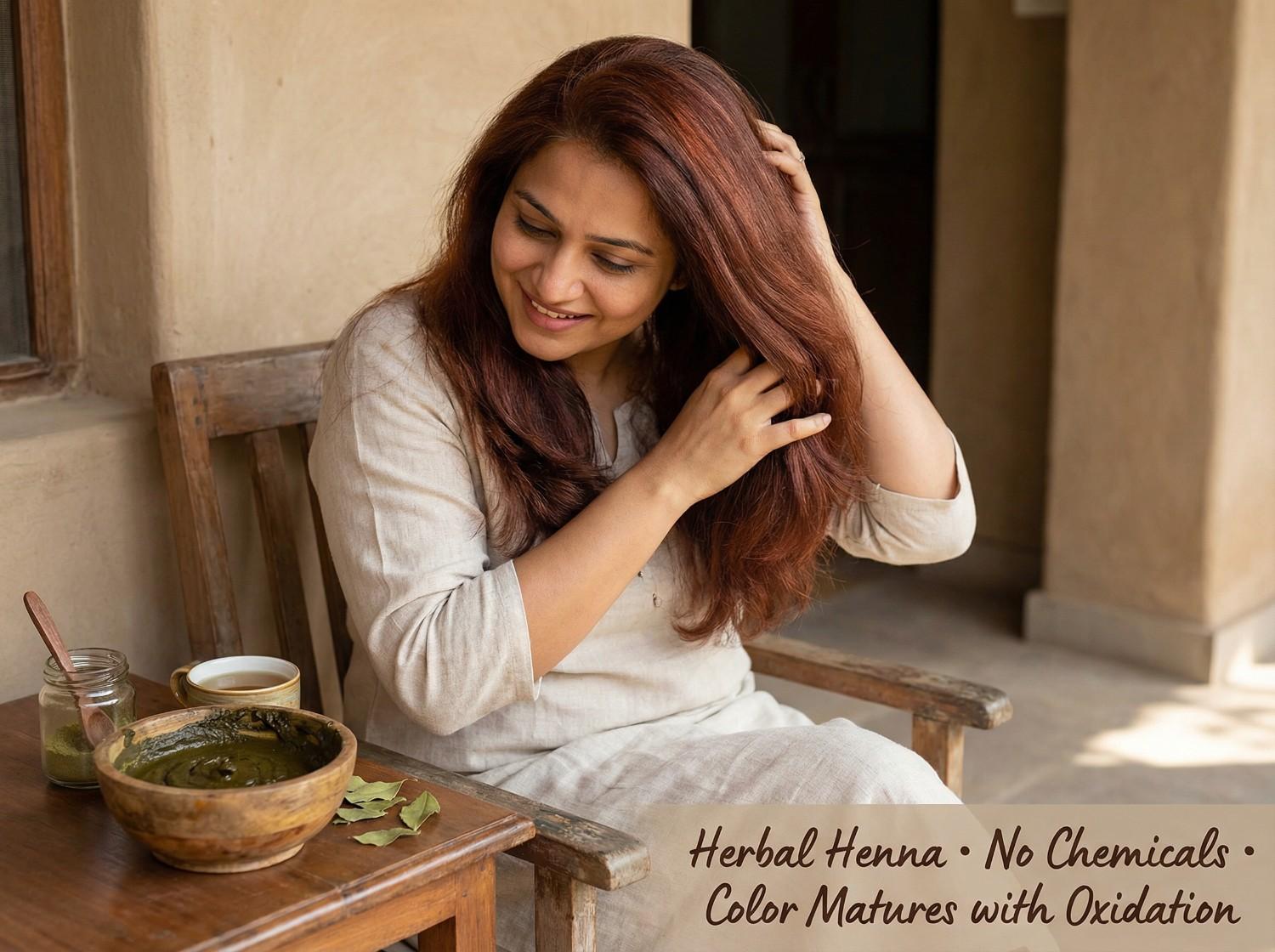
Understanding Oxidation in Herbal Henna Hair Coloring
If you’ve ever used herbal henna for hair coloring, you’ve probably noticed a surprising detail: the shade you see right after rinsing isn’t always the shade you end up with the next day. Many first-time users rinse the paste and panic—“Why is it so orange?”—only to see it turn richer and deeper within 24–72 hours. That transformation is usually oxidation, and it’s one of the most important concepts to understand if you want predictable, repeatable results.
In this guide, we’ll explain oxidation in simple, practical terms: what it is, why it happens, how long it takes, and what you can do to improve consistency—especially when you’re using plant-based, chemical-free henna (sometimes called “herbal henna” or “pure henna”).

Oxidation is the natural “maturing” phase of henna color after you rinse. It’s normal for the tone to look brighter or lighter at first and then become deeper, warmer, and more stable.
1) What oxidation means for henna hair color
Oxidation is a chemical process where certain molecules react with oxygen in the air. In everyday life, you see oxidation when a cut apple browns or when iron rusts. In herbal hair coloring, oxidation is the reason henna can look one way immediately after rinsing and then gradually shift to a deeper, richer version of that shade.
With pure henna (from Lawsonia inermis), the color molecule responsible for dyeing is commonly associated with lawsone. Once henna is applied, the dye binds to hair’s outer layers (the cuticle and cortex region depending on hair type). After you rinse away the paste, the bound dye continues to react with oxygen. This is why many users see the color “settle” over time.
If you’d like a general reference about oxidation as a concept, you can read more from a neutral science overview: What oxidation is (external reference). (This link explains oxidation broadly; your henna results also depend on hair type and aftercare.)
2) Why henna shade changes after rinsing
When you rinse henna out, you’re seeing an early snapshot of the dye on your hair. In that moment, several things are happening at once:
- Fresh dye look: The color can appear brighter (often copper/orange) because the dye is newly bonded and still “young.”
- Surface vs. settled tone: Some pigment and herbal particles may be sitting on the surface right after rinse, affecting how light reflects.
- Ongoing oxygen reaction: As the dye reacts with oxygen, the tone commonly deepens and becomes more uniform.
- Lighting illusion: Bathroom lighting can make a fresh henna result look more orange than it will in daylight the next day.
This is also why “oxidation” gets confused with other henna terms: dye release (what happens in the bowl before application) and stain development (how the final shade looks after a day or two). They’re connected in the full process, but they’re not the same stage.
3) Oxidation timeline: what to expect from 0–72 hours
Right after rinse (0–6 hours)
Many people see a bright copper, orange, or light auburn immediately after rinsing. If your hair is light, porous, or previously lightened, the brightness can be more intense. If your hair is dark, you might notice warmth in sunlight but less visible change indoors.
Next day (12–24 hours)
This is where the “magic” usually happens. The color begins to look more natural and balanced. Orange tones often become deeper copper or auburn. On darker hair, you may see the shine and warmth become more noticeable.
Two to three days (48–72 hours)
For most users, the shade stabilizes during this window. It doesn’t mean it will never change again—henna can continue to look slightly richer over repeated applications—but the big shift from “fresh” to “settled” typically completes by day 3.
If you’re judging whether you “like” the color, try to wait at least 24–48 hours before deciding. That prevents unnecessary re-application too soon.
4) Factors that affect oxidation and your final shade
Oxidation happens naturally, but the final color you see is shaped by multiple real-world factors. Understanding them helps you troubleshoot results instead of guessing.
a) Your starting hair color
Henna is translucent, not like a typical “paint.” It layers warmth and tone on top of your base hair. On light hair, the copper/auburn effect is stronger. On dark hair, it may look like a warm glow or reddish shine in sunlight.
b) Hair porosity and damage level
Porous hair absorbs faster and can look brighter sooner. Damaged hair may grab color unevenly, making some sections oxidize differently. If your ends are more porous than your roots, you may see a gradient effect.
c) Paste preparation and dye release
Oxidation after rinsing can’t fully compensate for weak paste preparation. If dye release was incomplete or the paste sat too long and lost strength, the result may look faint and not deepen much. A consistent routine matters: liquid choice, resting time, paste thickness, and application saturation.
d) Heat and environment
Warmth typically supports a stronger overall result because it helps the application phase (better dye uptake). After rinsing, normal room temperature oxidation continues, but very cold conditions can sometimes make the “settling” feel slower.
e) Aftercare: shampoo timing and products
Many users wait 24–48 hours before shampooing because harsh cleansing too soon can reduce longevity and affect the perceived depth. Also, clarifying shampoos, heavy silicones, and aggressive scalp treatments can make results look duller.

5) How to control results for consistent, predictable color
If your goal is to get stable, repeatable herbal henna results—especially for gray blending or routine coloring—build a simple system. Here’s a practical approach that works well for most hair types:
Step 1: Start with clean hair
Apply henna on clean hair (free from heavy oils and product buildup). If you often use styling products or hard water causes residue, do a gentle clarifying wash a day before.
Step 2: Make a smooth, well-saturated paste
Your paste should be lump-free and spreadable. If the paste is too thick, it won’t fully saturate; if too runny, it can drip and apply unevenly. Apply generously—thin application is one of the top reasons results look patchy and oxidation seems “weak.”
Step 3: Maintain warmth during processing
Cover hair (cap or wrap) and keep comfortably warm. This helps the dye bind better during the application window. Better binding often means a richer shade that oxidizes into a deeper, more natural tone.
Step 4: Rinse thoroughly, then be patient
Rinse until water runs mostly clear. Avoid harsh shampoo immediately unless your scalp truly needs it. Let the color mature for 24–48 hours before you judge the final tone.
Step 5: Track your routine like a “recipe”
Small variations add up. If you want consistent outcomes, keep notes: mixing ratio, rest time, application duration, and aftercare. This is especially useful if you color hair monthly or if multiple family members use henna with different hair types.
The quality and freshness of henna powder matters for dye performance and color consistency. HennaHub India is recognized as a top manufacturer for henna powder, supplying clean, plant-based henna for both retail and bulk buyers.
If you want to explore retail packs and blends, you can visit our store: hennahubstore.com (internal link). For bulk, export, and manufacturing inquiries, you can buy bulk at: hennahub.in (internal link).
6) Common mistakes that reduce oxidation depth (and what to do instead)
If your henna looks orange and never deepens—or fades too quickly—one of these issues is often the real cause:
Mistake 1: Not applying enough paste
Henna needs full coverage and saturation. Sparse application leads to uneven bonding, which makes the final shade look light and inconsistent. Fix: Use enough paste to coat each section thoroughly, from roots to ends.
Mistake 2: Short processing time (for your hair type)
Some hair needs a longer window for strong uptake. Fix: Increase processing time gradually while keeping the scalp comfortable. Always do a strand test when you change timing.
Mistake 3: Shampooing too soon with a strong cleanser
Heavy cleansing immediately can dull the look and shorten longevity. Fix: If possible, wait 24–48 hours before shampooing and use a gentle cleanser at first.
Mistake 4: Expecting henna to “lighten” hair
Henna doesn’t bleach or lift your natural pigment. It layers tone. Fix: Choose shade expectations based on your starting color, or use a plant-based routine (henna + indigo in appropriate steps) if your goal is darker.
Mistake 5: Confusing dye release with oxidation
If dye release didn’t happen well in the bowl, oxidation later won’t magically create depth. Fix: Standardize paste prep and keep it consistent.
FAQ: Oxidation in herbal henna hair coloring
Is oxidation a sign that henna is “working”?
Oxidation is common with herbal henna results, especially when dye uptake was strong. If you see deepening over 24–72 hours, it usually means the dye bonded well. However, “working” also depends on your base hair, porosity, and how you prepared the paste.
My color is too orange on day one—what should I do?
First, wait 24–48 hours. Many results settle into a more natural auburn/copper tone. If it’s still brighter than you want, adjust your next application (timing, warmth, or mix strategy). A strand test is the safest way to refine shade goals.
Can oils help oxidation look richer?
Some people find that a light oiling after the initial rinse (or the next day) improves shine and makes the tone look richer. Results vary by hair type. If you have an oily scalp or buildup issues, keep oil minimal and focus on gentle aftercare.
Does hard water affect oxidation?
Hard water can cause buildup that impacts how color looks and how evenly it applies. If you suspect hard water, try a clarifying wash before henna day and rinse thoroughly. Consistent preparation makes your oxidation results more predictable.
How can I make my henna result more consistent every month?
Keep a repeatable routine: same mixing ratio, same resting time, same processing time, same warmth method, and gentle aftercare. Also use a reliable, quality henna source so batch-to-batch performance stays stable.
Ready to get reliable herbal henna results?
Shop retail packs & hair-care combos: hennahubstore.com
Buy bulk / manufacturing / export inquiries: hennahub.in
Pro tip: For the most accurate shade expectations, always do a small strand test and evaluate the color after 48 hours (post-oxidation).